Terling Place, Neoclassical country house in Terling, England
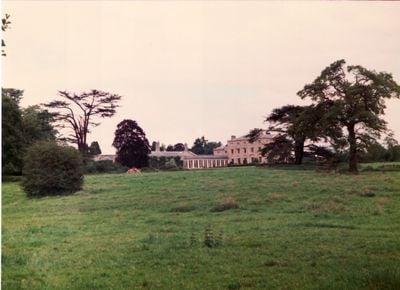
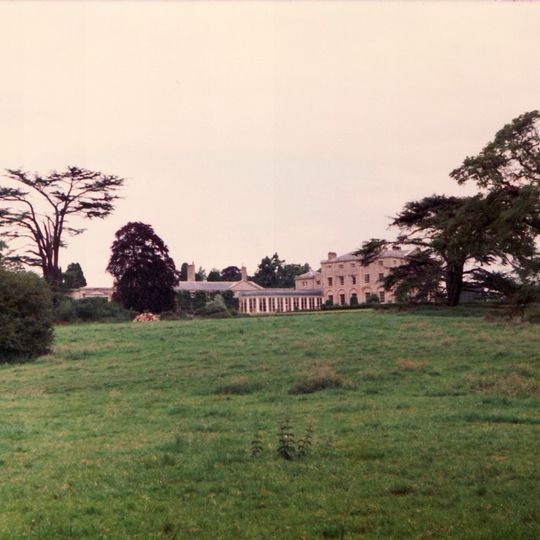
Terling Place is a neoclassical brick country house in Terling, Essex, featuring limestone details, a slate roof, and a three-story facade with two chimney stacks. The windows and doorways are evenly spaced across the front, giving the building a balanced, formal appearance.
John Johnson designed and built this house between 1772 and 1777 for John Strutt, a wealthy local landowner. It was then significantly expanded and refined between 1818 and 1824, reshaping much of its interior layout.
Terling Place is still home to the Strutt family, who have owned it since the 18th century. The classical columns framing the entrance and the rows of evenly spaced windows give the building a formal, orderly appearance that reflects the tastes of the landed gentry of that era.
The grounds are privately owned and not open to the public, but the exterior can be seen from the road nearby. Access to the interior requires prior permission from the owners.
Lord Rayleigh, who later won the Nobel Prize in Physics in 1904, carried out his laboratory experiments in the west wing of the house, leading to the discovery of argon in 1894. This makes the building one of the few private homes directly linked to a Nobel Prize-winning scientific discovery.
The community of curious travelers
AroundUs brings together thousands of curated places, local tips, and hidden gems, enriched daily by 91,381 contributors worldwide.