Solomon R. Guggenheim Museum, Art museum on the Upper East Side of Manhattan, New York City, United States.
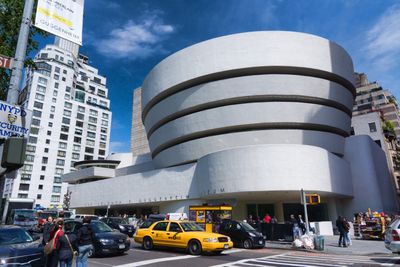
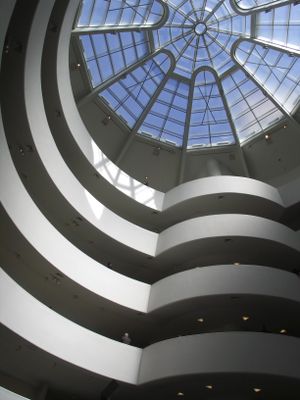
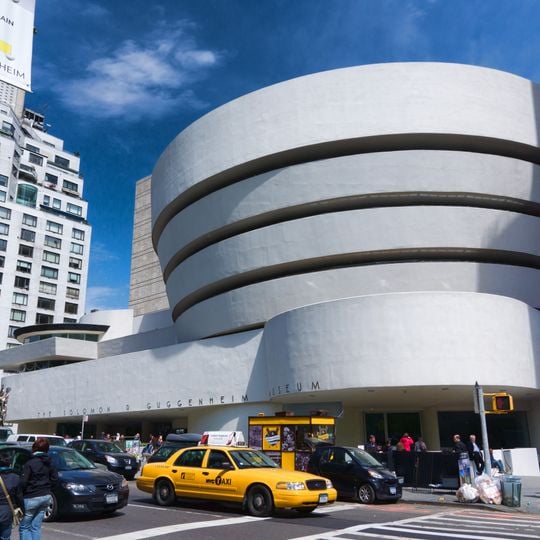
The Solomon R. Guggenheim Museum is an art museum on the Upper East Side of Manhattan, known for its spiral architecture. A continuous ramp winds upward through six levels beneath a glass dome, displaying modern and contemporary artworks along its curved walls.
Solomon R. Guggenheim founded the museum in 1937 and the Frank Lloyd Wright building on Fifth Avenue opened in October 1959. The structure is now considered one of the most important works of 20th century American architecture.
The museum's name honours Solomon R. Guggenheim, whose foundation opened it in 1939 as the Museum of Non-Objective Painting; it was renamed in 1952, three years after his death. Hilla von Rebay, its first director, had urged Guggenheim to collect non-objective art and wrote to Wright of wanting "a temple of spirit, a monument". The Thannhauser Collection, 70 works given in 1963 on condition of permanent display, hangs in the top three stories of the monitor.
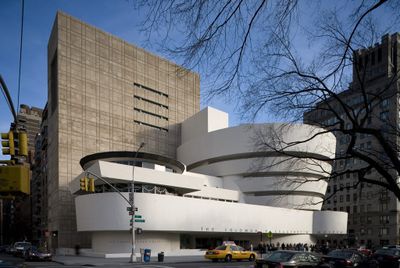
The entrance is at 1071 Fifth Avenue, between 88th and 89th Streets, with the monitor block and annex flanking the bowl-shaped gallery. The six-story ramp is continuous, so many visitors ride the elevator to the top and walk down. The building was closed for renovation from 1990 to 1992 and the facade was repaired between 2006 and 2008.
The building follows a nautilus shell pattern where the upper rings extend wider than the lower ones, creating an expanding vertical gallery space. Wright originally designed a red exterior, but the facade remained white.
The community of curious travelers
AroundUs brings together thousands of curated places, local tips, and hidden gems, enriched daily by 92,362 contributors worldwide.