Bohemian Forest, Mountain range in Czech Republic, Germany and Austria
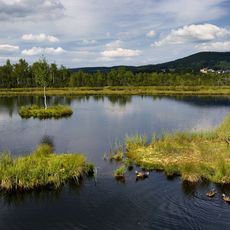
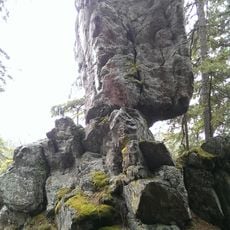
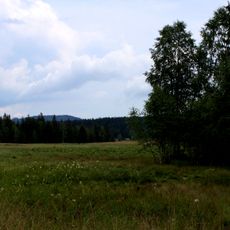
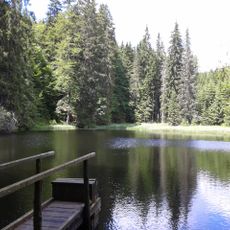
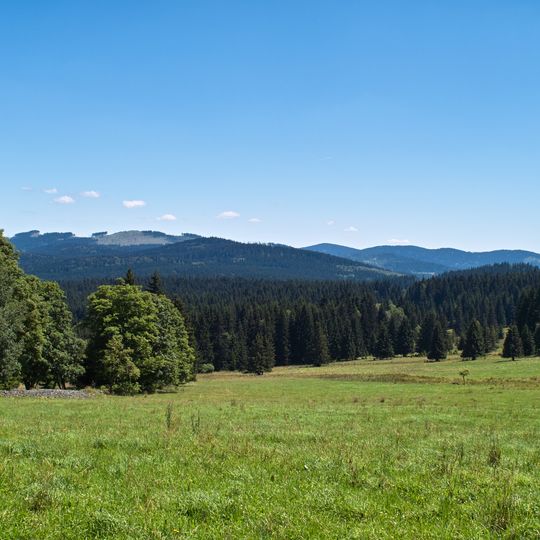
The Bohemian Forest, called Šumava in Czech and Böhmerwald in German, is a low mountain range along the borders of the Czech Republic, Germany and Austria. Its highest summit is the Großer Arber at 1456 m; the Plöckenstein/Plechý on the Czech-Austrian border reaches 1378 m. Dense coniferous forest covers the lower slopes, while the upper elevations are bare rock and thin vegetation.
The first recorded German name, Nordwald, appears in documents from 853 and 1010, when Emperor Henry II gave part of it to Niedernburg Abbey in Passau. From the 12th to 14th centuries, German-speaking settlers from Bavaria cleared and settled the forest edges, and the Goldener Steig trade route linked Bavaria and Bohemia. Many villages grew around 18th-century glassworks, such as Lenora, founded in 1834.
The name Šumava comes from the Proto-Slavic šuma, meaning dense forest; German Böhmerwald means "Bohemian Forest". Glassmaking shaped the region from the Middle Ages: a forest-glass hut landscape formed in the 14th century, and after crystal glass appeared shortly before 1700, Bohemia led the world glass trade for nearly 200 years. Villages such as Lenora, founded in 1834, began as glassworks sites and often end in "-hütte".
Hundreds of kilometers of marked trails wind through forests and over plateaus, passing small towns and mountain huts that offer rest and direction. The best months for walking are May through October, when paths are clear and shelters are open.
The watershed between the North Sea and the Black Sea runs through these forests, splitting rainfall into two opposite directions. Rivers such as the Vltava, Otava and Úhlava rise here and flow north, while other streams drain south toward the Danube.
The community of curious travelers
AroundUs brings together thousands of curated places, local tips, and hidden gems, enriched daily by 92,308 contributors worldwide.