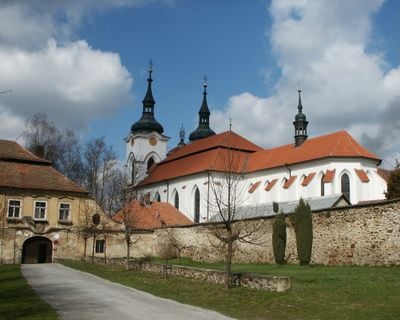
Želiv monastery, Premonstratensian monastery in Želiv, Czech Republic
Želiv monastery is a Premonstratensian abbey founded in 1139 above the Želivka. Its Church of the Nativity of the Virgin Mary has a Romanesque core, a Gothic triple nave and two towers in the facade; the convent is a square, one-storey building from the late 17th century by G. A. de Maggi, with glazed arcades around a courtyard.
Founded in 1139 by Duke Soběslav I, the monastery was settled in 1149 by Premonstratensians from Steinfeld in the Eifel. It burned in 1375, was plundered by Hussites around 1420, and in 1468 King George of Poděbrady pledged it to Burian Trčka of Lípa, who expelled the monks. After a 1712 fire, Jan Blažej Santini-Aichel rebuilt it in baroque Gothic style between 1713 and 1720.
The monastery's Latin name Siloe, after the biblical pool near Mount Zion, survives in the German form Seelau. Visitors can see a wall in the cloister ambits bearing the handwritten names of all the priests and monks held here, and an "Okurková monstrance" made secretly from a bottle base and pickle tins.
The monastery can be reached by car from nearby Humpolec and offers accommodation in its guesthouse for visitors seeking to stay overnight. You can also sample the beer produced in the monastery's own brewery and tour the traditional cloistered spaces.
Between 1950 and 1956, the communist regime used the monastery as an internment camp where more than 460 priests and monks were detained. This difficult chapter in 20th-century Czech history is an important context when visiting the site today.
The community of curious travelers
AroundUs brings together thousands of curated places, local tips, and hidden gems, enriched daily by 92,142 contributors worldwide.