Valdice Charterhouse, Carthusian monastery in Valdice, Czech Republic.
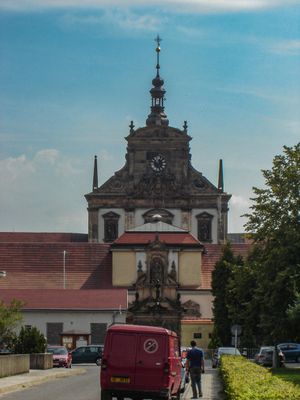
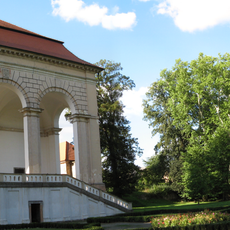
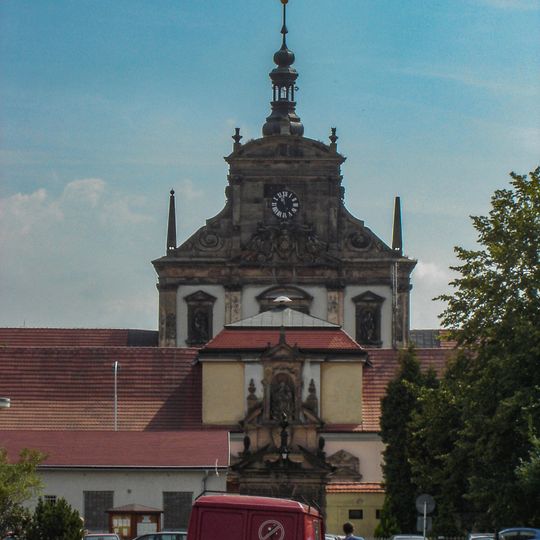
Valdice Charterhouse is a former Carthusian monastery near Jičín, begun in 1630 to designs by Andrea Spezza and finished in 1655 by Giovanni Battista Pieroni. Its buildings are laid out symmetrically along a west-east axis, with the Church of the Assumption of the Virgin Mary, a three-nave basilica with three pairs of side chapels, enclosed by the square cloister at the centre. The pale stone facade carries a black clock in a segmental pediment, statues of four patron saints in niches, and a lantern with a cupola and cross above.
Wallenstein founded the charterhouse as the northern endpoint of his architectural plan for Jičín. Andrea Spezza drew up the design in 1627, and construction began in 1630 under Giovanni Battista Spezza and Franz Latomus, continuing until 1655. In 1782 Joseph II dissolved the monastery; from 1855 to 1856 the Austrian administration rebuilt it as a prison, which still operates today.
The monastery represents the Carthusian tradition of monastic life, where monks lived in individual cells dedicated to meditation and strict spiritual practice. This way of life left a visible mark on how the buildings are arranged and connected.
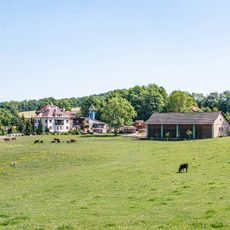
The site has served as a prison since the mid-19th century and remains one of the most heavily guarded prisons in the Czech Republic, so the grounds are not open to visitors. The former monastery church and the column with the statue of St John of Nepomuk from 1698 can be viewed from outside in Valdice near Jičín.
Wallenstein had a stone mausoleum built in the church for his burial, and his body was brought here from Cheb after his assassination. His remains were later moved to the castle chapel at Mnichovo Hradiště, so the tomb never held him permanently.
The community of curious travelers
AroundUs brings together thousands of curated places, local tips, and hidden gems, enriched daily by 92,985 contributors worldwide.