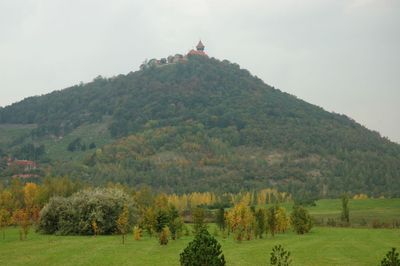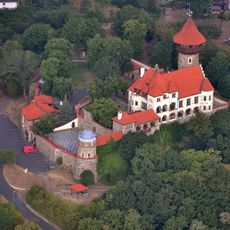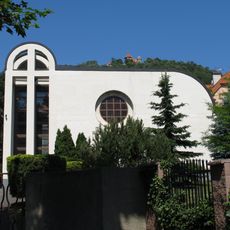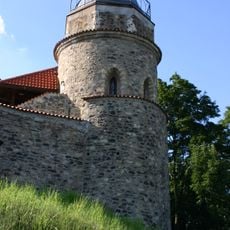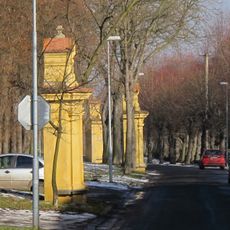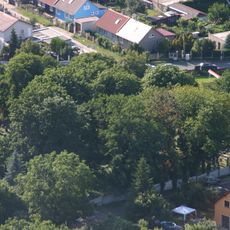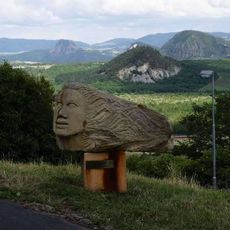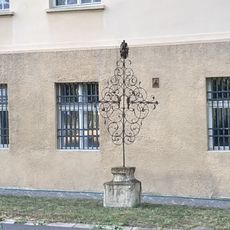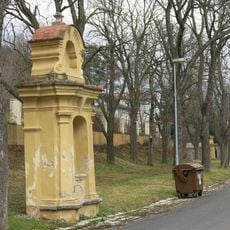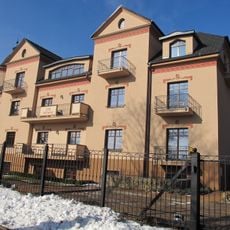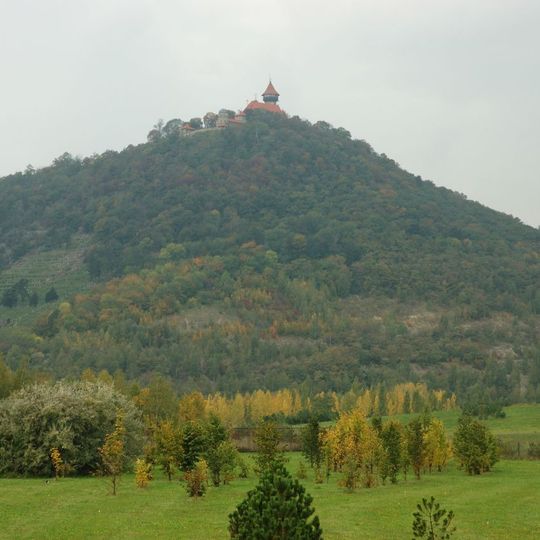
Hněvín, Summit with castle ruins in Most, Czech Republic.
Hněvín, also called Schlossberg, is a phonolite hill of volcanic origin rising to 407 m above sea level on the northern edge of Most. Its summit holds the modern Hněvín castle with an observation tower, a landmark visible from afar. The hill is partly wooded and terraced with vineyards.
A fortified hilltop settlement probably stood here in the 9th century and was later rebuilt in stone. The castle was demolished shortly after the Thirty Years' War and rebuilt around 1900; the present structure was restored in 2000–2001. Charles IV granted Most's burghers the right to plant vineyards in 1374.
The name Hněvín comes from Hněva, a member of the Hrabišic family who settled this area in the early Middle Ages; the Czech form replaced the older Zámecká hora (Schlossberg) around 1900. Charles IV granted Most's burghers the right to plant vineyards here in 1374, and vines were replanted on the old terraces in 2004.
The summit is reached by the street Hněvín, repaired during the castle's 2000–2001 reconstruction, and the hill's slopes were reforested after the Mostecký koridor was built. A waterworks building stands in the saddle on the western side, and the city of Most has planned a cycle path running over the summit.
The hill is a 27.4-million-year-old phonolite volcanic neck, and its rock is unusually low in nickel and chromium but rich in zircon and niobium. Vineyard terraces on the south slope, first granted to Most burghers by Charles IV in 1374, were replanted in 2004.
The community of curious travelers
AroundUs brings together thousands of curated places, local tips, and hidden gems, enriched daily by 92,178 contributors worldwide.