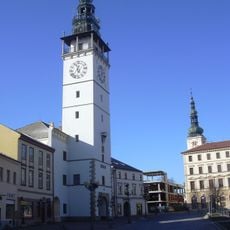
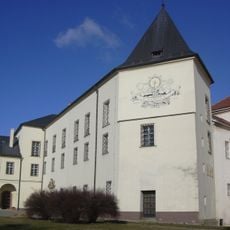
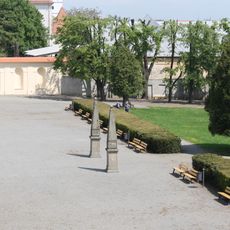
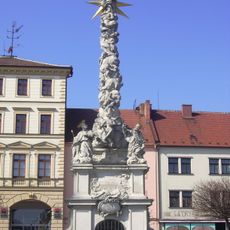
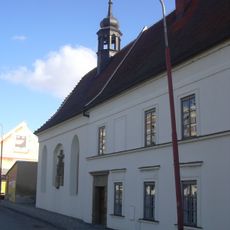
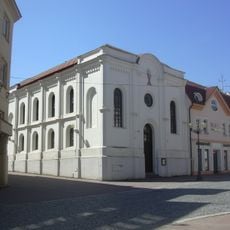
Church of the Assumption of the Virgin Mary, Gothic church in Vyškov-Město, Czech Republic
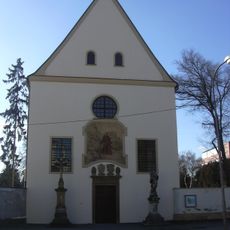
The Church of the Assumption of the Virgin Mary is a three-nave hall church without a tower, built between 1464 and 1496 near the town walls; its west prism tower was added in 1729–1735. The Gothic nave was baroquised in 1773–1789 to designs by G. P. Tencalla, and the interior holds an altar painting of the Assumption by Ignác Wiedliech and a ceiling fresco of the Coronation of the Virgin.
The present church was built between 1464 and 1496 as a three-nave hall without a tower, on a new site by the town walls, funded by Bishop Tas of Boskovice and Černá Hora to reward the parishioners' loyalty. It was burned by Duke George of Münsterberg and only consecrated in 1496 by Bishop Andrew of Nicopolis. A west tower was added in 1729–1735, and the Gothic nave was baroquised in 1773–1789 to designs by G. P. Tencalla.
The church holds three chapels: the Chapel of Our Lady of Sorrows, dedicated to the fallen of the First World War, the Chapel of St Wenceslas with a nativity scene installed each year, and the Chapel of St Ottilie with a painting of St Louis IX. The first two replaced a German chapel whose last German Pentecost sermon was held in 1860.
The church stands in the town centre near the remains of the town walls, a short walk from the town hall and the chateau. Entry is through three portals, from the south, west and north; the north portal faces the former wall. The crypt, built in 1760 and reopened in 1898 during paving work, lies beneath the floor.
The Swedish army took Vyškov in 1644 and looted the church, smashing its newly built organ. Dean Adam Tubernátor buried the church valuables and building funds under the Altar of the Holy Cross, but the Swedes found them there too.
The community of curious travelers
AroundUs brings together thousands of curated places, local tips, and hidden gems, enriched daily by 92,853 contributors worldwide.