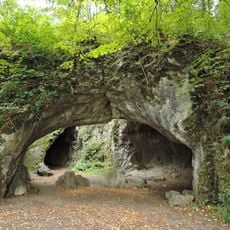
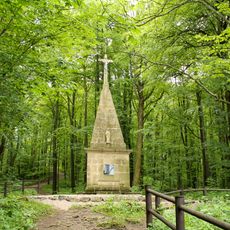
Kotouč, Prehistoric archaeological site at Kotouč hill in Štramberk, Czech Republic.
Kotouč was a hillfort on an oval limestone hill with two peaks and a saddle, about one kilometre south of Štramberk at roughly 539 metres. A 1943 survey found a rampart on the northern perimeter, while the southern part had already been quarried; the site is now completely destroyed by the quarry.
The hilltop was settled in the Moravian Painted Ware culture of the Late Stone Age, the Silesian phase of the Lusatian Urnfield culture, the Platěnice culture of the Hallstatt period and the late La Tène. The rampart dates to the Urnfield period; whether the site was a Celtic oppidum or a Púchov hillfort remains unresolved. Karel Jaroslav Maška introduced it to archaeology in 1884, and František Prošek and Lumír Jisl led the first rescue excavations in 1950.
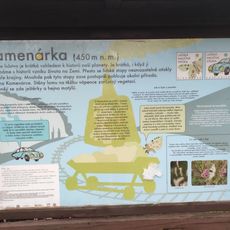
The name Kotouč survives only as the hill's name; the hillfort itself was quarried away. The site is also known for the butterfly jasoň červenooký (Parnassius apollo), recorded here as its only Czech locality; in 1994 a specimen caught in Slovakia was released here.
The hillfort no longer exists: limestone quarrying removed the entire site on the summit of Kotouč, about one kilometre south of Štramberk's centre. There is nothing to explore or excavate, so the former rampart and the estimated thirteen-hectare extent can only be studied in the literature, such as Čižmářová's 2004 encyclopaedia of Moravian Celts.
The hillfort was known locally from the 1860s, but Karel Jaroslav Maška only brought it into archaeological literature in 1884, while researching the nearby Šipka cave. Jan Knies summarised its settlement in 1929, and the first rescue excavations came only in 1950, led by František Prošek and Lumír Jisl.
The community of curious travelers
AroundUs brings together thousands of curated places, local tips, and hidden gems, enriched daily by 92,529 contributors worldwide.