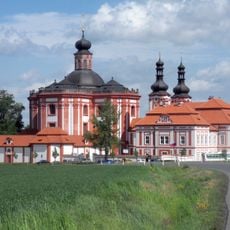
Hubenov, Cultural monument in Hradecko, Czech Republic
Hubenov is a four-winged Baroque farmyard of the Plasy Cistercian monastery, built around a diagonally set square courtyard with a small free-standing dairy building at its centre. In the southeast corner stands the six-sided residential block with a mansard roof and onion-domed bell turret, faced by an identical granary in the opposite corner.
The village of Hubenov was founded in 1337 by locator Petr of Kralovice on Plasy monastery land; its poor soils gave it the name Hubenov. In the early 18th century abbot Evžen Tyttl had its twelve farmsteads cleared and built a large farmyard to an earlier design by Jan Blažej Santini-Aichel, begun in 1726 after the architect's death. The yard was confiscated in 1785 under Joseph II and largely burned in 1927.
The name Hubenov, used for the village founded in 1337 on poor land, means roughly "meagre" or "poor" place. The farm's chapel, dedicated to St Eugenie, has a five-sided ground plan that turns circular where the walls meet the vault, a hallmark of Santini's work.
The building is undergoing reconstruction, so visitors should expect limited access or ongoing work. Check ahead before planning a visit to understand the current conditions at the site.
The chapel of St. Eugenie inside the residence has a pentagonal ground plan that turns circular where the walls meet the vault, a hallmark of Santini's design. The farm was built from 1726, six years after Santini's death, by master builder Matěj Ondřej Kondela.
The community of curious travelers
AroundUs brings together thousands of curated places, local tips, and hidden gems, enriched daily by 92,121 contributors worldwide.