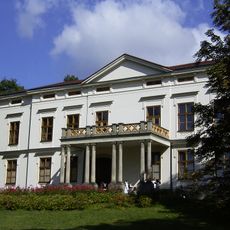
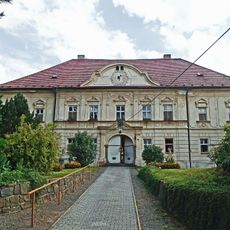
Hustopeče nad Bečvou Castle, Renaissance château in Hustopeče nad Bečvou, Czech Republic.
Hustopeče nad Bečvou Castle is a two-storey Renaissance château of square plan with four wings around a rectangular inner courtyard, at the southern edge of the town by the I/35 road towards Valašské Meziříčí. The courtyard's lower floors carry arcades on slender Ionic columns with a conical balustrade, and the three Renaissance wings bear psaníčková sgraffiti; a lower late-Baroque north wing, added after 1740, closes the fourth side. It has no exhibition yet.
Hustopeče was first recorded in 1349, when Milota of Bránice transferred it to his brother Beneš, who soon sold it to Jan and Drslav of Kravař. A fortress existed by 1569, when it appears on Fabricius's map of Moravia. Around 1580 Karel of Žerotín and his wife Johanka Černčická of Kácov began rebuilding it as a two-storey Renaissance castle with four wings, finished before 1604.
The castle served as a residence for several noble families over the centuries, each leaving traces of their taste and wealth in the rooms. The architecture shows how power and culture were connected in this region.
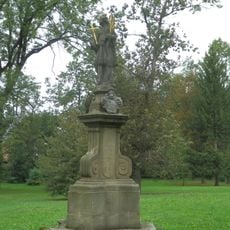
The castle stands about 10 km east of Hranice na Moravě, on the southern edge of Hustopeče nad Bečvou, right beside the I/35 road toward Valašské Meziříčí. It has no exhibition installed, so visits focus on the exterior and the former ornamental grounds, laid out in the second half of the 18th century and reworked into a landscape park in the first half of the 19th century.
The castle holds the tombstone of Viktorín of Žerotín (died 1611), eldest son of founder Karel the Elder of Žerotín. Viktorín was long mistaken for the castle's builder, though he only completed the interior work. The tombstone is kept inside the building.
The community of curious travelers
AroundUs brings together thousands of curated places, local tips, and hidden gems, enriched daily by 94,942 contributors worldwide.