Mariánský vrch, Mountain summit in Ústí nad Labem Region, Czech Republic
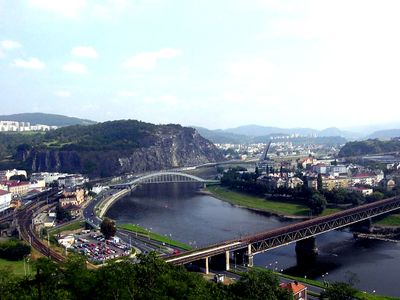
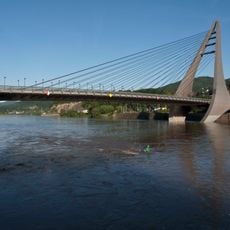
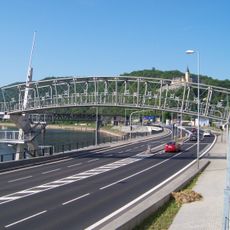
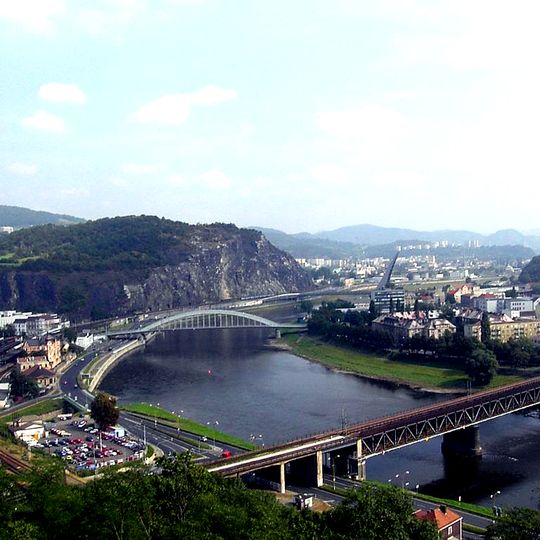
Mariánský vrch, called Marienberg in German, is a phonolite massif rising to 265 m on the left bank of the Labe in central Ústí nad Labem, about 120 m above the river. With the opposite Kramolna rock it forms the Ústecká brána gate, where the Mariánský most bridge was built at the end of the 20th century. A quarry cuts its eastern slope, and a 3 m thick river-terrace deposit near the top yielded a tooth of the elephant Archidiscodon meridionalis.
A chapel dedicated to the Visitation of the Virgin Mary stood on the summit until it was demolished in 1976; plans exist to rebuild it. The hill's phonolite mass was long quarried, and the rock's unusual composition led to the name marienbergite. A tooth of the elephant Archidiscodon meridionalis was found in a river-terrace deposit 120 m above the Elbe.
A Chapel of the Visitation of the Virgin Mary stood on the summit until it was demolished in 1976; plans exist to rebuild it. The hill's name, Mariánský vrch or Marienberg, refers to this Marian dedication, and the former chapel site remains the point where visitors recall that history.
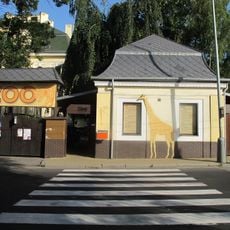
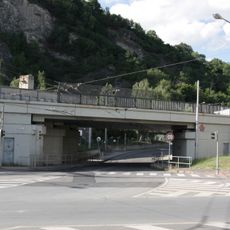
Mariánská skála rises about 200 m east of Ústí nad Labem's centre, on the left bank of the Labe, with the zoo and a quarry on its eastern slope and the Dobětice housing estate along its northern edge. The railway corridor and the road to Děčín pass below its southern drop. The former chapel site on top is gone, so there is no building to enter.
The phonolite massif gave its name to marienbergite, a rock type so specific in composition that it received its own designation. Its quarry is a rich site for zeolite minerals, especially natrolite, which makes up as much as 40% of the rock here.
The community of curious travelers
AroundUs brings together thousands of curated places, local tips, and hidden gems, enriched daily by 92,324 contributors worldwide.