Rabštejn nad Střelou, Castle ruin in Rabštejn nad Střelou, Czech Republic
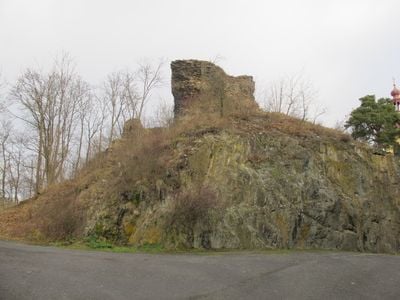
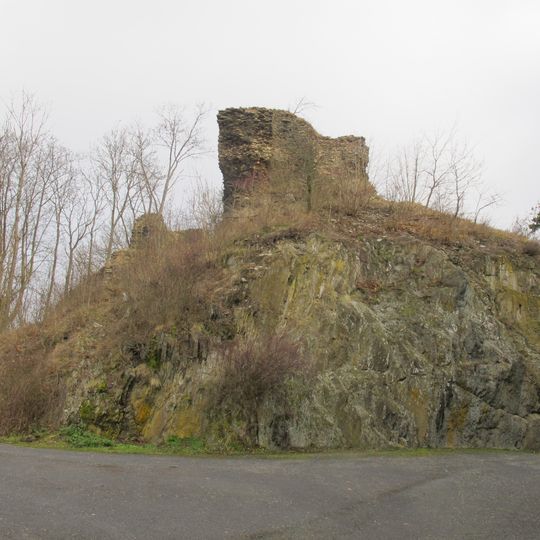
Rabštejn nad Střelou is a castle ruin on a steep rock outcrop above the Střela River, now reduced to a tall, jagged wall of rough dark grey and brown stone and mortar, widest at its base and narrowing upward. The most visible remnant is the torso of a second round tower and a curtain wall at the front of the site; the tower stood to full height until it collapsed in 1819. Bare trees stand to the left, and the rock face below is streaked with grey, green and yellowish tones.
Oldřich Pluh z Rabštejna founded the castle and town in the 1330s; his sons surrendered it to Charles IV in 1357 for 3,000 kop of Meissen groschen. Wenceslaus IV pledged it in 1397, and after 1532 fires and changing owners it decayed into a ruin. From 1705 František Karel z Pöttingu rebuilt the old castle as a Baroque château.
The castle gave its name to the town of Rabštejn nad Střelou. A Carmelite monastery founded by Burian II of Gutštejn in 1483 stood by the castle until the townspeople burned it in 1532; a Servite monastery with the Church of Our Lady of Sorrows, attributed to Anselm Lurag, was built in 1666 on the site. The castle is now a cultural monument of the Czech Republic.
The castle stands on a promontory above the Střela, with the western side cut off by a natural rock cleft that now carries the road to Manětín. The grounds are uneven and partly overgrown; the empty Servite monastery next door is closed to visitors, while the chateau usually opens in summer.
The round bergfrit tower stood at full height until 1819, when it collapsed; only its ground floor remains. It was built because Sychrov Castle was founded higher up, and the tower let Rabštejn's garrison watch that neighbouring castle. A drawing from 1470 and an engraving by Mauritius Vogt from 1712 record the tower's former form.
The community of curious travelers
AroundUs brings together thousands of curated places, local tips, and hidden gems, enriched daily by 92,231 contributors worldwide.