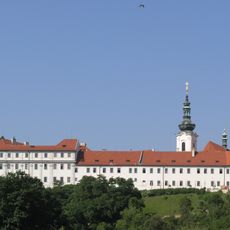
Church of Saint Roch, Renaissance church in Hradčany, Prague, Czech Republic
The Church of Saint Roch is a late Renaissance single-nave building with Gothicizing elements and a composite ground plan: a rectangular nave with a presbytery of the same shape, two pentagonal side chapels and a pentagonal apse evoking the arms of a cross. The nave is vaulted with a barrel vault and two pairs of triangular lunettes.
Rudolf II vowed in 1599, during a plague in Bohemia, to build a church to Saints Sebastian and Roch; the foundation stone was laid on 7 June 1603 on the site of a decayed chapel of Saints Felix and Adauctus. The shell was finished before the emperor's death in 1611, and the church was consecrated in 1617 by Archbishop Jan Lohelius. Dissolved in 1784 under Joseph II, it served as a forge before Abbot Zikmund Antonín Starý restored it and reconsecrated it on 15 October 1882.
The church is dedicated to Saint Roch, one of the plague patrons to whom Rudolf II vowed a new church in 1599, alongside Saint Sebastian. Three Baroque altars were commissioned by Emperor Ferdinand II and Empress Eleonora for the three plague saints: Roch in the apse, Sebastian and Anthony the Hermit in the side niches.
Access to the chapel is through Strahovské nádvoří in Prague's Hradčany district, where visitors can explore both its architectural features and religious purpose. The location is easy to reach on foot and sits near other monastery attractions.
The church's three Baroque altars were commissioned by Emperor Ferdinand II and Empress Eleonora. In 1684 the builder Jan Jiří Gottwig was buried in the church, and in 1713 the painter Krodel. During the Prussian invasion the church was damaged by artillery fire and restored in 1747–1748, when F. X. Palko's painting of Saint Roch was installed on the main altar.
The community of curious travelers
AroundUs brings together thousands of curated places, local tips, and hidden gems, enriched daily by 92,721 contributors worldwide.