Vrchlabí Castle, Cultural monument in Vrchlabí, Czech Republic.
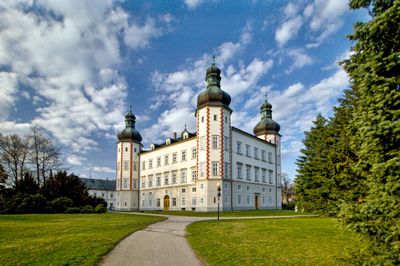
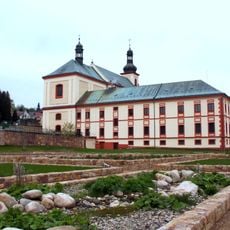
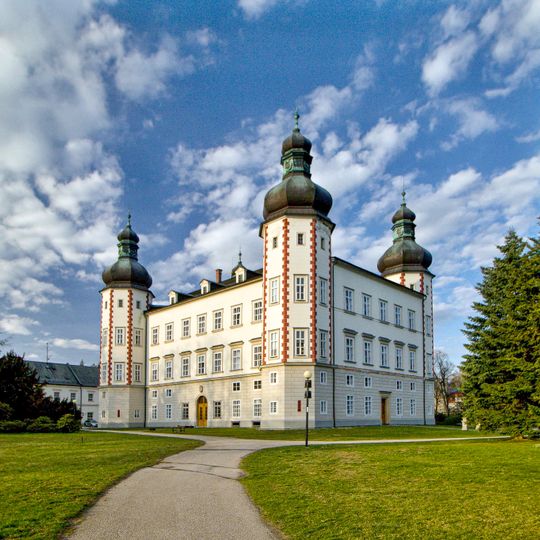
Vrchlabí Castle is a Renaissance château near the town square, built from 1546 to 1548 for Kryštof of Gendorf on the site of a Gothic water fortress. It has a rectangular two-storey body with four prismatic corner towers topped by onion domes with lanterns, and a large vaulted hall with lunettes inside.
A Gothic water fortress of the Vrchlabí squires stood on the site before the castle. In 1533 the Carinthian mining expert and royal councillor Kryštof z Gendorfu bought the estate for 1,750 Bohemian groschen and built a Renaissance residence on a Saxon-Silesian model; the main works ran from 1546 to 1548, and the old fortress then served only economic purposes. A fire damaged the upper floors in 1575, and the repairs and extensions of 1605–1614, probably involving the Italian Carlo Valmadi, gave the castle its present form.
The castle has housed the Vrchlabí municipal office since 1945, when it passed from private owners to the Czechoslovak state and later to the town. Weddings and concerts take place in its halls, and the central ground-floor space is freely open to the public.
Vrchlabí Castle now houses the Městský úřad (town hall), so most rooms are offices and not open to tourists. The central ground-floor space is freely accessible to the public. Weddings and concerts are held in the building, and a marked nature trail runs through the castle park.
The 1545 Renaissance tile stove, over 3.5 metres tall and decorated with coloured faience tiles showing biblical scenes, bears the coat of arms of Frederick II, Duke of Legnica and Brzeg. It is the only piece of the original Renaissance furnishings to survive and now stands in the castle's meeting hall.
The community of curious travelers
AroundUs brings together thousands of curated places, local tips, and hidden gems, enriched daily by 94,022 contributors worldwide.