Evangelical church, Gothic Revival church in Zábřeh, Czech Republic.
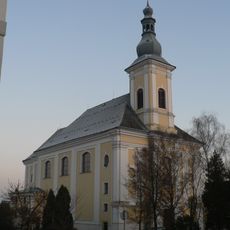
The Evangelical Christ Church in Zábřeh is a free-standing Gothic Revival building of dark fired brick with light stucco framing, raised slightly above the terrain and partly cellared. It has a cross-shaped plan, a 45-metre tower with bells and a clock, and a 3.5-metre cross on its pyramidal roof. The church is 27.7 m long and 15.6 m wide, with a single nave under a 12-metre imitation rib vault.
Wilhelm Engelbert Brass, founder of the Hohenstadt dye works, donated the church shortly before his death in 1896; his sons Otto and Hermann carried out the building in 1902–1903 to plans by the local master builder Karl Ilgner. The completed church made Hohenstadt an independent Protestant parish in 1905. Since 1946, after the German population was expelled, it has served the Czechoslovak Hussite Church.
The church was built for Zábřeh's German Protestant community, which had formed around the textile dye works of Wilhelm Engelbert Brass, who came from Elberfeld. Brass donated the building shortly before his death in 1896; his sons Otto and Hermann carried it out. Since 1946 it has served the Czechoslovak Hussite Church, whose services leave the interior without images or statues.
The church stands not in the centre but in the southern park area of Zábřeh, on the bank of the Moravská Sázava. The main entrance faces west and is reached by five sandstone steps; the building sits slightly raised above the surrounding ground and is partly cellared.
The tower clock was made in 1902 by Rudolf Thöndel of Uničov. Damaged at the end of World War II, it stood still for decades until a group of clockmakers repaired it in 2003. The organ by Kloss of Krnov, with 14 registers, was restored in 2013 after a public collection raised 626,000 CZK.
The community of curious travelers
AroundUs brings together thousands of curated places, local tips, and hidden gems, enriched daily by 94,346 contributors worldwide.