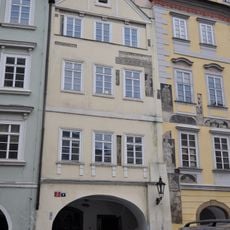
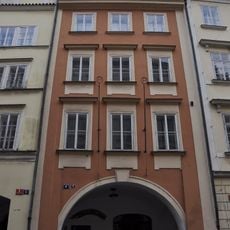
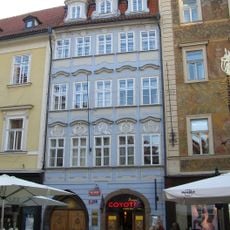
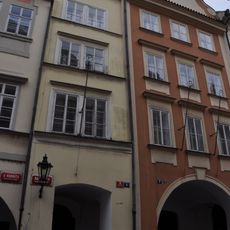
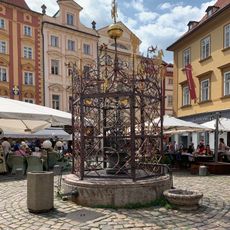
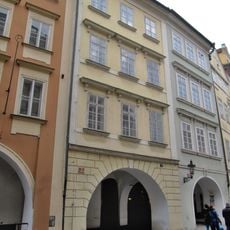
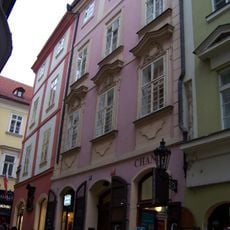
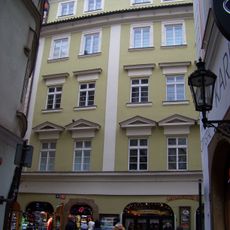
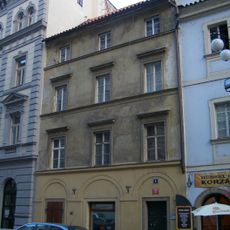
Rott house, Cultural monument in Malé náměstí, Czech Republic.
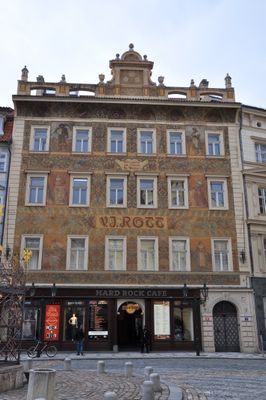
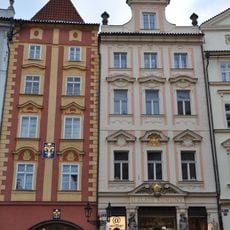
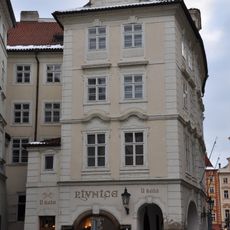
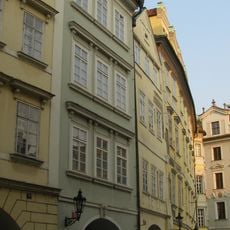
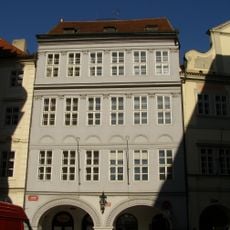
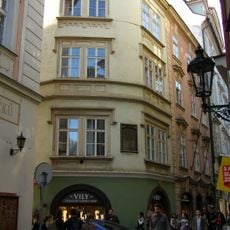
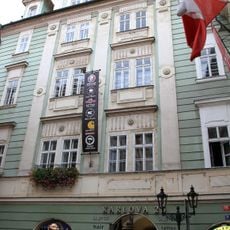
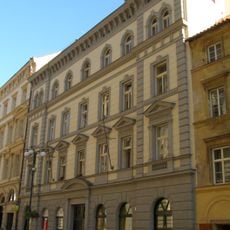
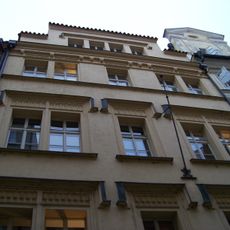
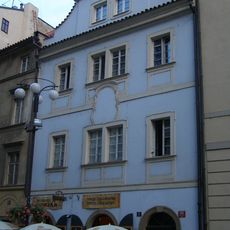
The Rott house is a three-storey, six-axis row building on Malé náměstí in Prague's Old Town. Its neo-Renaissance facade, rebuilt by František Kindl in 1896–1897, carries plant motifs and allegories of crafts and agriculture painted by Láďa Novák and Arnošt Hofbauer after designs by Mikoláš Aleš. A lunette cornice, attic balustrade with vases and lanterns, and a central shield crown the front; the basement preserves a Romanesque vaulted room.
The structure originated in the early 15th century and was later acquired by the Rott family, who renovated it thoroughly. This renovation transformed it into a department store and gave it its present-day appearance.
The facade paintings, made in 1896–1897 after designs by Mikoláš Aleš, show a blacksmith, carpenter, woodcutter, reaper, housekeeper and gardener, with metal tools in the lunettes. Between the first and second floors runs the name V. J. Rott; between the second and third, the old Czech hymn line "Nedej zahynouti nám ni budoucím Sv. Wáclave!" The house is still sometimes called Pytlíkovský dům, after Jan Pytlík, co-editor of the first printed Czech Bible in 1488.
The building is accessible to visitors who can admire the facade from outside or visit the restaurant located on the ground floor. The best time for photographs is early afternoon when light enhances the details of the sgraffito decoration.
The facade paintings were not painted by Mikoláš Aleš himself: he supplied the designs, and Láďa Novák and Arnošt Hofbauer executed them during the 1896–1897 rebuild by František Kindl. The lunettes show metal tools, and between the second and third floors runs the motto "Nedej zahynouti nám ni budoucím Sv. Wáclave!"
The community of curious travelers
AroundUs brings together thousands of curated places, local tips, and hidden gems, enriched daily by 94,004 contributors worldwide.