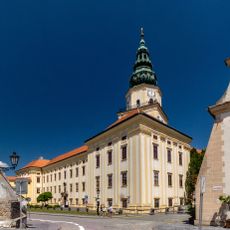
Maxmiliánův vodovod, Classical water system in Kroměříž, Czech Republic.
The Maxmiliánův vodovod is a single-storey square building of 1838 by Anton Arche, its gable wall with a stone fountain and spout facing Kroměříž Castle and the Mill Gate. At the centre of the gable sits a cast-iron coat of arms of Bishop Maxmilian Joseph Sommerau-Beckh, and beneath the cornice above the basin runs a metal-letter inscription ending MDCCCXXXVIII.
Bishop Maxmilian Joseph Sommerau-Beckh commissioned this water system in 1838 to transport water from springs on Barbořina Hill into the city. It was built to replace an older water tower that had previously stood in Štěchovice.
The cast-iron coat of arms of Bishop Maxmilian Joseph Sommerau-Beckh sits at the centre of the gable, and below the cornice metal letters read "MAXMILIAN JOSEPH SEINER GUTEN SCHUTZSTADT CREMSIER MDCCCXXXVIII" — German for "to his good protective town of Kroměříž, 1838". The bishop's name and the year are thus built into the facade itself.
The fountain water is non-potable and classified as utility water only. The structure no longer distributes water; it stands as a protected classical monument in the buffer zone of the UNESCO World Heritage site Gardens and Castle at Kroměříž. The stone fountain and spout face the castle and the Mill Gate on Na Kopečku street, next to the Bajda municipal swimming pool and the former brewery and soda factory.
The system was designed by architect Anton Arche and demonstrates early 19th-century engineering methods. Its construction shows how water could be efficiently moved over distances into urban areas at that time.
The community of curious travelers
AroundUs brings together thousands of curated places, local tips, and hidden gems, enriched daily by 93,439 contributors worldwide.