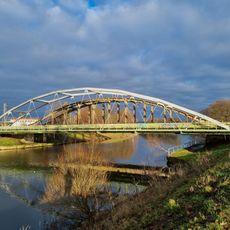
Elbe bridge in Plácky, Stone bridge across Elbe River in Plácky, Czech Republic
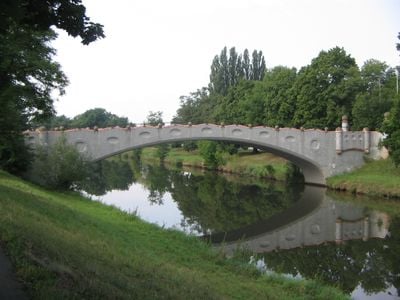
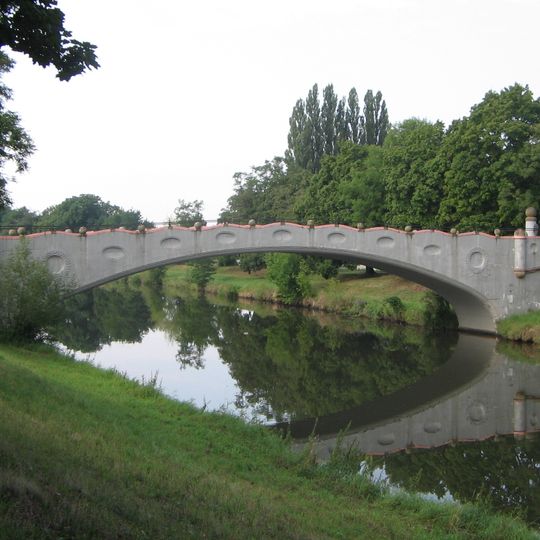
Kamenný most, known locally as Kameňák, is a reinforced-concrete road bridge over the Elbe linking Věkoše and Plácky. Built in 1911–1912 to František Sander's design, it has a single low segmental arch, a solid parapet of artificial stone with decorative spheres, and wide convex curves at the entrances with low pylons on plinths. The deck is only 5 m wide, with granite paving and two small footways.
A wooden footbridge stood on this site from the late 18th century until it was demolished in 1907 during river regulation works on the Elbe; the Austrian Northern Army used it as a retreat route. František Sander was commissioned to design the replacement in 1910, the Hradec Králové firm of František Jirásek built it, and it was approved for use on 28 April 1912. It was listed as a cultural monument on 3 May 1958, and a repair costing 7 million crowns followed in 1997–1998.
Locals call the bridge Kameňák, or the bridge at Plácky. Its railings of artificial stone are topped with decorative spheres, and the entrances open out in wide convex curves between low pylons built from ring-shaped segments. The retreat route of the Austrian Northern Army once passed over the wooden footbridge that preceded it.
The bridge is only 5 metres wide, so traffic crosses in a single direction. It carries two small footways and a single-lane roadway surfaced with granite paving and stone kerbs. The railings are solid artificial stone, widening at the entrances between low pylons on plinths.
The bridge is nicknamed Kameňák or "bridge at Plácky". At the end of World War II German troops mined it and a wooden bridge was built a short distance upstream; the mines were removed, but one reportedly fell into the Elbe and was never recovered.
The community of curious travelers
AroundUs brings together thousands of curated places, local tips, and hidden gems, enriched daily by 92,641 contributors worldwide.