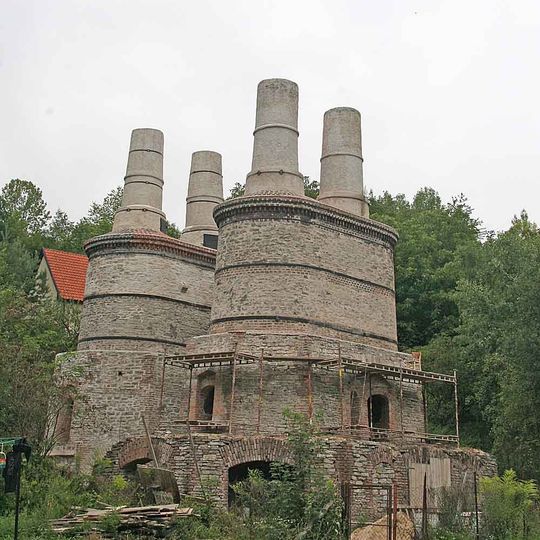
Pacoldova vápenka, Lime kiln in Velká Chuchle, Prague, Czech Republic
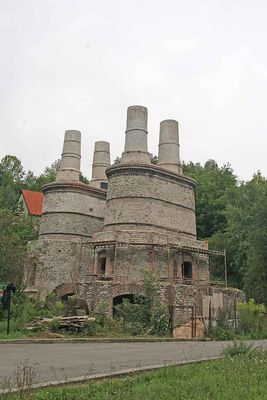
Pacoldova vápenka is a limestone processing facility in Velká Chuchle with two connected kilns, each featuring two cylindrical shafts topped by a pair of chimneys. The structure was designed to process unsorted limestone directly without preliminary screening.
Built before 1880 in Velká Chuchle, the kiln used Jiří Pacold's patent for burning unsorted limestone; construction of this kiln type was halted that year in favour of circular kilns. Operations stopped at the start of World War I, were revived in 1935 by the merchant Šuran, and ended definitively in 1938, after which stone from the site was processed at the circular kiln in Hlubočepy. After 1948 the state-owned complex decayed, and in 1966 it was declared a technical monument.
The site shows how a limestone works operated in the 1800s, with its visible structures revealing the production process and daily labor practices. Walking through the complex gives a sense of the industrial rhythm that defined the neighborhood.
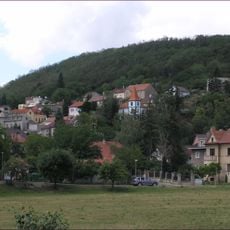
The kiln stands in the western part of Velká Chuchle, beside the road from Prague toward Slivenec. It is a former industrial site, not a staffed museum, so there are no opening hours or guided tours; the structures are seen from the road and the surrounding ground. The walls were partly collapsed and had to be held together with metal bands, so keep to the outside and do not enter the kiln shafts.
A narrow railway with tracks just 450 millimeters wide connected this facility to the nearby Homolka quarry. This miniature rail system was essential for moving raw stone across the daily production cycle.
The community of curious travelers
AroundUs brings together thousands of curated places, local tips, and hidden gems, enriched daily by 94,498 contributors worldwide.