Josefov Fortress, Military fortress in Jaroměř, Czech Republic.
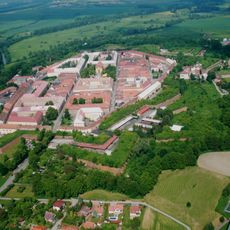
Josefov Fortress is a brick bastion fort begun in 1780 on the Elbe and Metuje rivers near Jaroměř, designed by French engineer Claude-Benoît Duhamel de Querlonde. Its walls enclose 289 hectares, and three storeys of tunnels run 45 km through cretaceous rock. The town inside has four gates and a grid of identical houses around the Empire-style garrison church.
Emperor Joseph II ordered the fortress built in 1780 around the village of Ples, and work finished in 1787 under the design of French engineer Claude-Benoît Duhamel de Querlonde. Leopold II gave it the name Josephstadt in 1792. It never faced a siege, but served as a prison holding Hugo Kołłątaj and, after the January Uprising, General Marian Langiewicz. It lost fortress status in 1888 and was joined to Jaroměř in 1948.
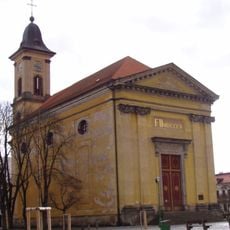
The fortress church, the Empire-style garrison church begun in 1805 and finished in 1810, dominates the walled town; Heinrich Hatzinger, Julius D'Andreis and Franz Joseph Fohmann designed it. Streets laid out at right angles are lined with identical stone houses, and the neo-Renaissance New Town Hall now holds a museum. The town was first called Ples and was renamed Josefov in 1793.
About one kilometre of the 45 km of underground corridors and casemates is open to visitors, entered on guided tours. The New Town Hall, a neo-Renaissance building, houses a museum. The streets inside the walls cross at right angles, so orientation is easy once you pass the gates.
The fortress hosts a major metal music festival each August that draws performers and fans from across Europe. This unexpected use shows how historical sites gain new purpose in contemporary cultural life.
The community of curious travelers
AroundUs brings together thousands of curated places, local tips, and hidden gems, enriched daily by 92,644 contributors worldwide.