Newichawannock Canal, Historic water canal in Wakefield, United States.
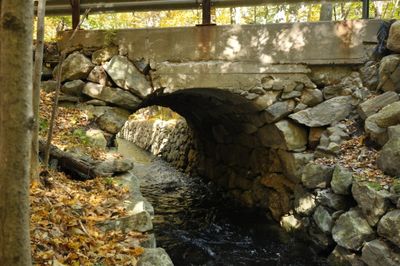
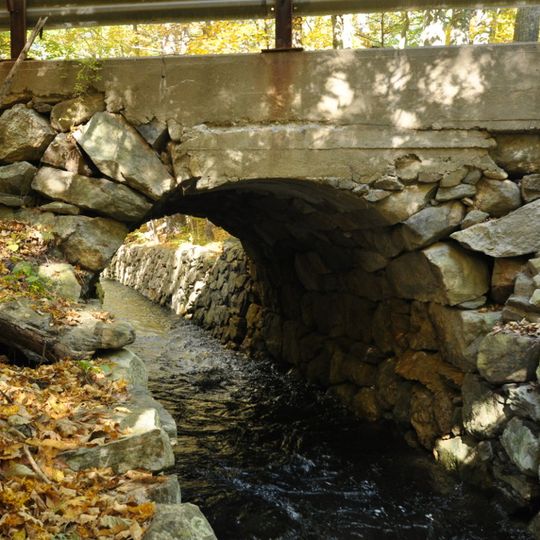
The Newichawannock Canal is a 0.75-mile (1.21 km) man-made waterway linking Great East Lake to Horn Pond on the New Hampshire–Maine border. It is 13 feet (4.0 m) wide and about 16 feet (4.9 m) deep, lined with unmortared stone. An unmortared stone-arch bridge built at the same time carries Canal Road over it, and piles of leftover construction stone lie nearby.
The Great Falls Company, founded in 1823 to run textile mills at Somersworth, New Hampshire, bought water rights at Great East Lake and Horn Pond and began the canal in 1850 to increase flow at its mills. Construction, delayed partly by the Civil War, was not completed until the 1860s; the work was carried out by Hiram Paul, a civil engineer who lived in Wakefield and kept a tavern. Other mills, such as the Cocheco Woolen Mills in East Rochester, benefited in later decades.
The name Newichawannock comes from the Abenaki word for the Salmon Falls River, meaning "river with many falls". The canal was dug by Hiram Paul, a civil engineer who lived in Wakefield and ran a tavern there. Stone left over from construction still lies in piles beside the waterway.
The canal runs between Great East Lake and Horn Pond along the Maine–New Hampshire line, and Canal Road crosses it on the unmortared stone-arch bridge. As of 2020 the northern half is largely blocked by collapsed sides; the southern half is navigable and reached from Horn Pond.
The canal crosses the border between Maine and New Hampshire, making it one of the rare National Register sites that spans two states. This location reflects an unusual partnership between communities on opposite sides of a state line.
The community of curious travelers
AroundUs brings together thousands of curated places, local tips, and hidden gems, enriched daily by 93,601 contributors worldwide.