Equestrian statue of George Washington, Equestrian statue in the Public Garden, Boston, United States
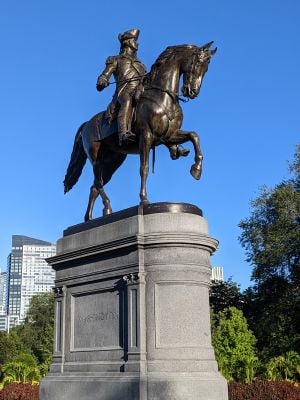
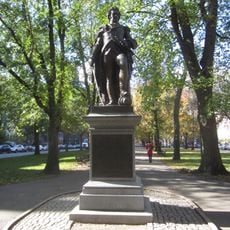
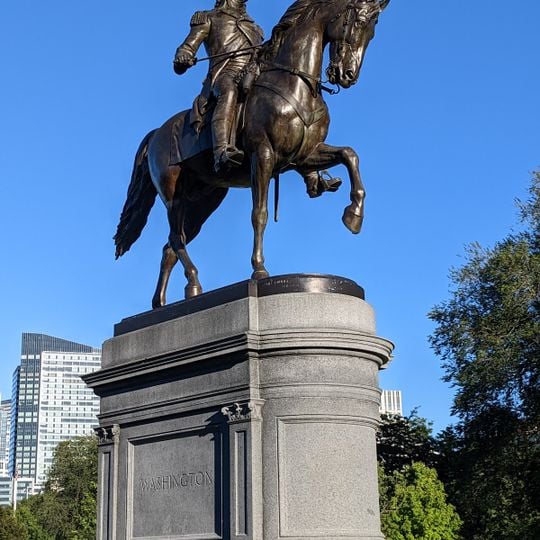
The equestrian statue of George Washington is a bronze sculpture by Thomas Ball in Boston's Public Garden, Massachusetts. The bronze measures about 22 by 6 by 15 feet and rests on a granite base of about 16 by 8 by 15 feet. Commissioned in 1859, modeled in 1864, and cast and dedicated in 1869, it was surveyed by the Smithsonian's "Save Outdoor Sculpture!" program in 1993.
The monument was commissioned in 1859, modeled by Boston sculptor Thomas Ball in 1864, and cast and dedicated in 1869. Alexander H. Rice, who chaired the fundraising committee, argued in an 1859 speech that the statue should show Massachusetts's own resources: a Boston artist, modeling in the city, bronze cast in a Massachusetts foundry. The Smithsonian's Save Outdoor Sculpture! program surveyed it in 1993.
The monument was conceived to present Massachusetts as an artistic center: Alexander H. Rice, who chaired the fundraising committee, said in 1859 that the statue would be modeled and cast in bronze within the state by a Boston artist. Thomas Ball, its sculptor, was a Boston citizen. Visitors can look for the sword, now a fiberglass substitute because bronze replacements were repeatedly broken or stolen.
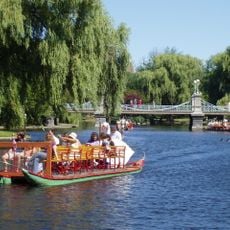
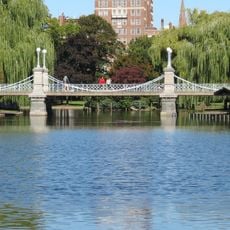
The statue stands in the Public Garden, Boston's central park bounded by Charles Street, Boylston Street, Arlington Street and Beacon Street. It is reached on foot along the garden paths, near the pond and the bridge, and can be circled to view it from several sides.
The statue's sword has repeatedly been broken and stolen over the years; rather than recasting a bronze replacement each time, caretakers fitted a fiberglass substitute. The bronze was modeled in 1864 and cast and dedicated in 1869, and the Smithsonian surveyed it in 1993.
The community of curious travelers
AroundUs brings together thousands of curated places, local tips, and hidden gems, enriched daily by 94,492 contributors worldwide.