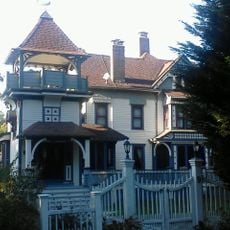
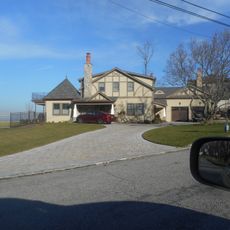
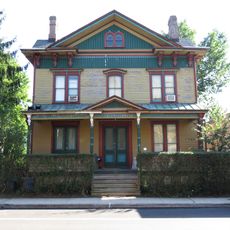
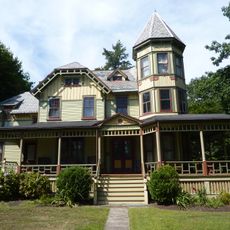
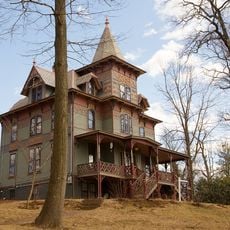
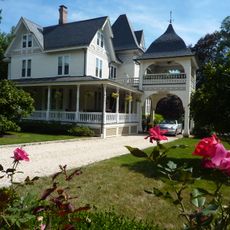
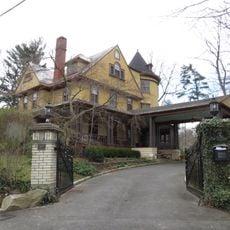
Killenworth, Tudor Revival mansion in Glen Cove, United States.
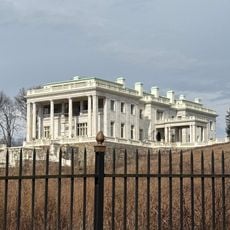
Killenworth is a 39-room Tudor Revival mansion built in 1912 for George Dupont Pratt, designed by Trowbridge and Ackerman with a seam-faced granite facade. It replaced an earlier 1897 mansion of the same name by William Tubby, and its gardens were designed by James Leal Greenleaf.
Construction of this mansion began in 1912, a time when Tudor Revival architecture was gaining popularity among wealthy American homeowners. The project coincided with a broader movement of replicating European architectural traditions as a symbol of prosperity and cultural refinement.
Killenworth was bought by the Soviet Union in 1946 as the country retreat of its UN delegation; Vyacheslav Molotov was among the first residents. Nikita Khrushchev's 1960 visit drew crowds that reportedly threw tomatoes at his party's limousines, while other residents watched in silence. Fidel Castro also visited while in the United States. The Russian delegation still uses the mansion.
Killenworth is a private estate still used by the Russian delegation to the United Nations, so the house and grounds are not open to visitors. The Tudor Revival mansion stands in a residential part of Glen Cove on Long Island, and its granite facade can only be seen from the public street. The City of Glen Cove revoked the Russians' permits for its beach, golf and tennis facilities in 1982, reversed in 1984.
Killenworth is one of five surviving Glen Cove mansions built for the sons of oil magnate Charles Pratt; together their estates once covered nearly 5,000 acres. The others are The Braes, now the Webb Institute, Welwyn, Poplar Hill and The Manor. The 1912 house replaced an earlier Killenworth that William Tubby designed for George Dupont Pratt around 1897.
The community of curious travelers
AroundUs brings together thousands of curated places, local tips, and hidden gems, enriched daily by 94,215 contributors worldwide.