Gordon–Van Tine Company Historic District, Historic industrial district in Davenport, United States.
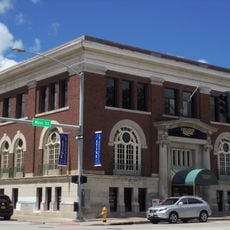
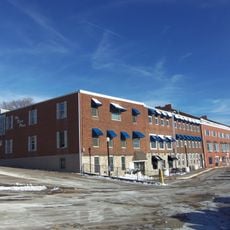
The Gordon–Van Tine Company Historic District comprises four contributing brick and concrete buildings east of downtown Davenport. Building #1, the four-story office, has a limestone foundation, a stone-surrounded entrance, a limestone water table and string course, and a Neoclassical brick entablature; its first three floors went up in 1908–1909 and a fourth was added before 1923. Building #2 is a five-story reinforced concrete structure with brick curtain walls and pilasters on the third through fifth floors, finished in 1910. A single-story former four-car garage and a long lumber shed with street-side loading doors and railroad-side docks complete the group.
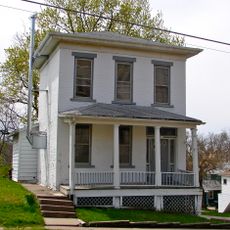
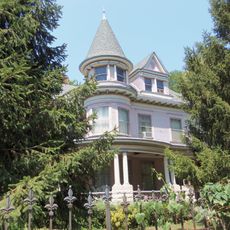
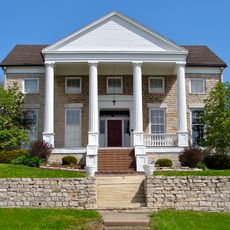
Gordon–Van Tine was incorporated in 1907 as a subsidiary of the U.N. Roberts lumber company, first selling building materials from several buildings in the 300 block of Harrison Street. By 1910 it offered house plans and became one of the first American firms to sell fully pre-cut houses, moving into this facility around 1916. The company sold an estimated 54,000 homes under its own name and supplied lumber for 20,000 Wardway homes for Montgomery Ward from 1917. It was liquidated in 1946.
The district's name comes from the Gordon–Van Tine Company, a subsidiary of the U.N. Roberts lumber company incorporated in 1907. The firm sold an estimated 54,000 homes under its own name and supplied lumber for another 20,000 Wardway homes for Montgomery Ward from 1917. The former office building now holds 15 apartments and the factory/warehouse 98, part of a $35 million project finished in 2019.
The complex sits east of downtown Davenport, near the corner of Federal and Charlotte Streets. The $35 million conversion, begun in 2000 and finished in summer 2019, produced 15 apartments in the former office building and 98 in the former factory/warehouse, plus ground-floor retail space. The residential units are private, so view the brick facades and the 1965 east addition from the public street.
The company sourced lumber from mills in multiple states including Washington, Missouri, Louisiana, and Mississippi to support production. This far-reaching supply network was key to keeping costs down and shipping homes nationwide.
The community of curious travelers
AroundUs brings together thousands of curated places, local tips, and hidden gems, enriched daily by 94,473 contributors worldwide.