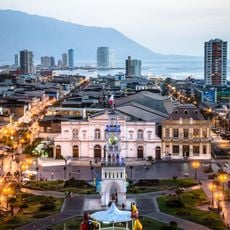
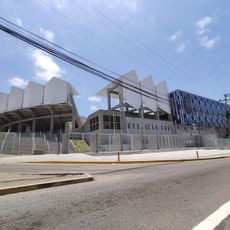
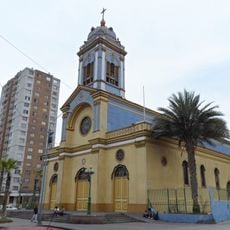
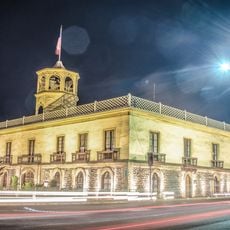
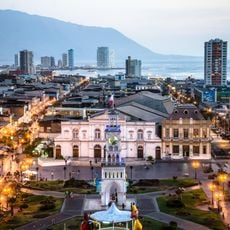
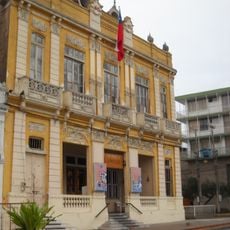
Cárcel Pública de Pisagua, Historical prison in Huara, Chile.
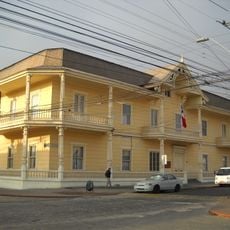
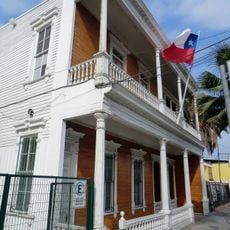
The Cárcel Pública de Pisagua is a two-story neoclassical building of masonry with stucco and cement finishes, constructed in 1910. Its protected polygon, defined in 2008, covers 1,390.24 m². It stands in Pisagua, in the Huara commune of the Tamarugal Province, Tarapacá Region.
Built in 1910 as a penal facility, the prison exploited Pisagua's natural isolation as a port. On 18 March 1942 a 'Presidio Especial' section opened to hold homosexual inmates separately; it was moved to Chanco on 29 August 1952. The prison later held political prisoners under Gabriel González Videla, Carlos Ibáñez del Campo and the military dictatorship, with women detained in the right-hand section of the Teatro Municipal, now the market. It was declared a National Monument by Supreme Decree No. 780 of 3 December 1990.
The site shows how imprisonment operated in an isolated desert town during the early 20th century through its architecture and layout. Visitors can see the daily conditions prisoners faced by walking through the cell blocks and courtyards.
The protected polygon fixed in 2008 covers 1,390.24 m², so the whole compound can be walked in a short visit. The building stands in Pisagua, Huara commune, Tarapacá Region, on the natural separation of the port; approach on foot from the town.
A special section called 'Presidio Especial' operated within the building from 1942 to 1952 for a particular group of detainees. This separated area reveals how the facility adapted its operations over different decades.
The community of curious travelers
AroundUs brings together thousands of curated places, local tips, and hidden gems, enriched daily by 93,640 contributors worldwide.