Atacama Giant, Geoglyph in Huara, Chile.
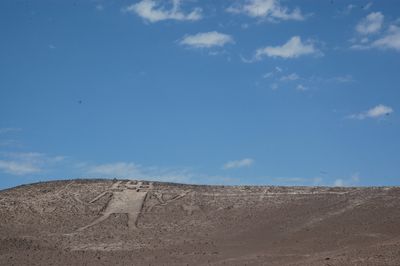
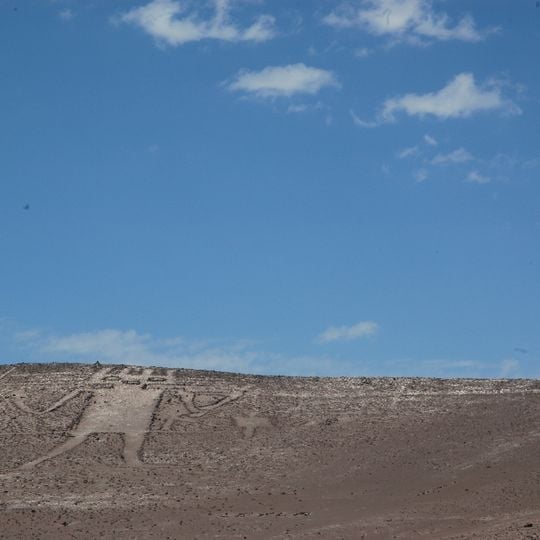
The Atacama Giant is an anthropomorphic geoglyph on the northwest flank of Cerro Unita, about 15 km from Huara in Chile's Tarapacá Region. It is 86 metres long, with a rectangular head topped by a vertical line, arms extending to the sides and legs splayed wide. It was made by piling stones and clearing the ground surface.
The Atacama Giant was made between 1000 and 1400 CE, attributed to successive cultures of the region including the Tiwanaku and Inca. It was first spotted from the air in 1967, during an exploratory flight by Eduardo Iensen Franke with archaeologists Delbert True, Lautaro Núñez and M.C. Mandoff. In 2019 the Cerro Unita area and 1,144 surrounding hectares were declared a Protected National Asset.
Researchers suggest the figure depicts a shaman or yatiri, and some link it to the Andean deity Tunupa-Tarapacá, said to have travelled from Lake Titicaca to the Pacific. The same hillside holds at least 21 other geometric and animal figures.
The figure lies on the northwest flank of Cerro Unita, about 15 km from the village of Huara in the Tarapacá Region. It is best viewed from a distance or from raised ground, since the whole 86-metre outline cannot be taken in from close up. The surrounding hill holds at least 21 other geometric and animal figures.
The figure remained unseen from ground level for centuries because piled stones gradually blended with the rocky surroundings. Only from the air did the full form and pattern become visible to modern observers.
The community of curious travelers
AroundUs brings together thousands of curated places, local tips, and hidden gems, enriched daily by 92,605 contributors worldwide.