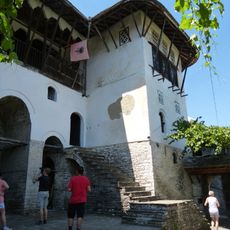
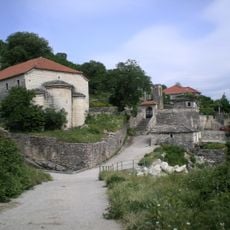
Gjin Aleksi's Mosque, Ottoman mosque in Rusan village near Delvinë, Albania
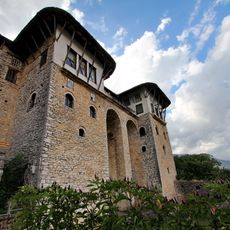
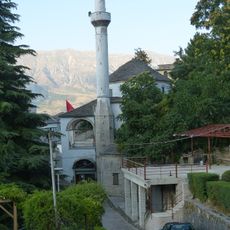
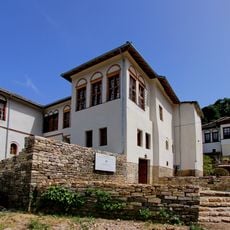
Gjin Aleksi's Mosque stands on a small hillside terrace in Rusan, ringed by four hexagonal turrets of differing sizes. Its 8-by-8-metre prayer hall is preceded by a wooden upper gallery resting on a stone wall diaphragm, and the whole dome rises on an octagonal base. The minaret has lost its roof, and a women's gallery sits by the entrance.
The prayer hall was likely built in the last quarter of the 16th century, and the porch in the first quarter of the 17th. Evliya Çelebi mentions the mosque of the Gjin Aleks quarter around 1670, describing it with vineyards and gardens. It later became a Bektashi centre, and in 1963 it was designated a Cultural Monument of Albania.
Evliya Çelebi recorded the mosque around 1670 as belonging to the "Gjin Aleks" quarter, "full of vineyards and gardens." A plaque found at the site points to links with Sufi orders, possibly the Halveti, and the building later became a Bektashi centre whose babas were buried in the hexagonal turrets.
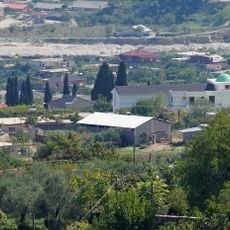
The mosque stands on a small hillside terrace in Rusan, reached from the Delvinë area; the prayer hall itself measures 8 by 8 metres. The minaret has lost its roof, and the four surrounding turrets differ in size, so the outline is easy to recognise from the village. Visitors enter through the wooden gallery that precedes the hall.
The acoustics come from small niches in the walls holding clay vessels, a detail easy to miss without looking closely. The Albanian source links the building to a funeral complex with a monumental fountain and to the practices of a Sufi order, possibly the Halveti.
The community of curious travelers
AroundUs brings together thousands of curated places, local tips, and hidden gems, enriched daily by 94,080 contributors worldwide.