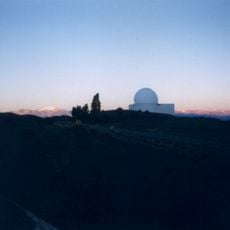
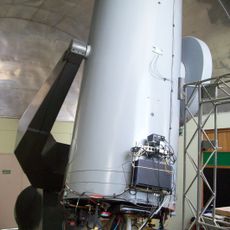
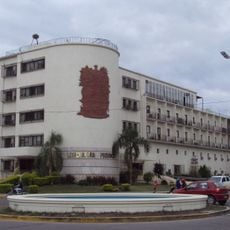
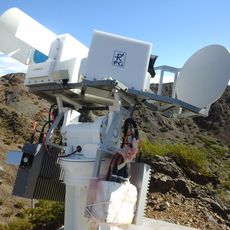
Solar Submillimeter Telescope, Radio telescope at the Leoncito Astronomical Complex, San Juan Province, Argentina
The Solar Submillimeter Telescope is a solar-dedicated radio telescope at the Leoncito Astronomical Complex in San Juan Province, Argentina. It uses a 1.5-meter Cassegrain antenna to observe submillimeter radiation at 212 and 405 GHz, wavelengths produced by high-energy particles during solar flares.
The facility began making observations in April 1999 and entered regular daily operations in April 2001. A partnership between CONICET Argentina and Mackenzie University Brazil established the foundation for its ongoing research mission.
Since April 2001 the SST has been run daily under a joint agreement between Argentina's CONICET and Mackenzie Presbyterian University of Brazil, so the site is staffed and operated by both countries. The 212 and 405 GHz observations come from a focal array on the 1.5-meter Cassegrain antenna, and the data feed solar-flare research in both nations.
The telescope sits at high elevation in a remote mountain setting, which provides excellent conditions for observations but requires careful planning to visit. Access is restricted and arrangements must be made in advance through the research facility.
The instrument captures high-energy particles released during solar eruptions, with some observed patterns remaining unexplained by current solar physics theories. These puzzling observations help push scientific understanding forward and guide future research directions.
The community of curious travelers
AroundUs brings together thousands of curated places, local tips, and hidden gems, enriched daily by 93,003 contributors worldwide.