Villavicencio Natural Reserve, Nature reserve in Mendoza Province, Argentina.
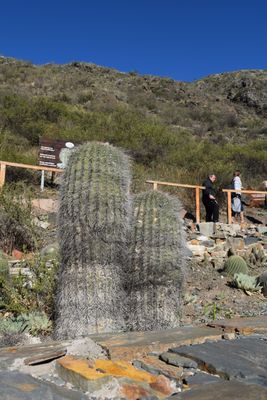
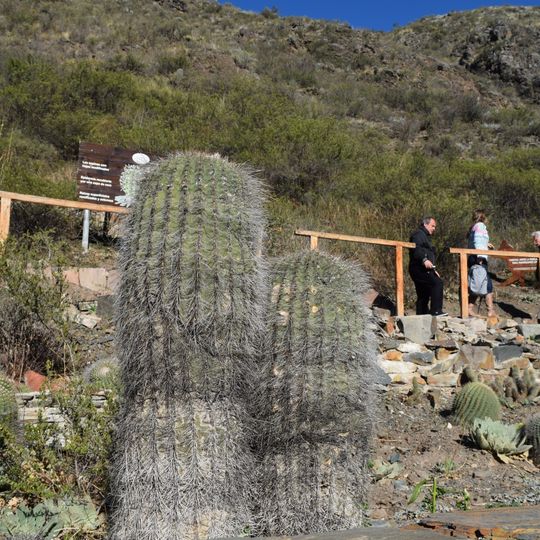
Villavicencio Natural Reserve covers 62,000 hectares in the Las Heras department of Mendoza, between the Uspallata valley and the eastern plains of the Andean foothills, 50 km from Mendoza city. A columnar cactus with a thick trunk and pale spines stands beside a wooden fence and a sign reading "Reserva Natural Villavicencio" and "Monumento Natural Cardón".
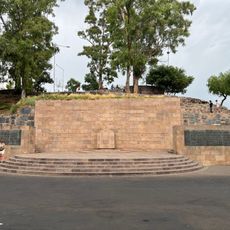
The area served as a key passage in 1817 when General San Martín's troops crossed the Andes during their military campaign. The Canota monument marks where the army divided into separate routes.
The Canota petroglyphs in the El Manzano ravine consist of anthropomorphic, zoomorphic and geometric figures carved on three large blocks, dated between the 4th and 10th centuries AD. The reserve also contains the Canota monument, marking where Las Heras's column separated from San Martín's Liberation Army before the 1817 Andes crossing.
The reserve is divided into different zones to balance visitor access with environmental protection. Some areas welcome general exploration, while others remain restricted to preserve sensitive habitats.
In January 2020, camera traps set by the Andean Cat Alliance, the Villavicencio Foundation and Argentina's Environment Secretariat photographed two Andean cats, a species listed as the most threatened in the Americas. The previous sighting nearby dated from 2008.
The community of curious travelers
AroundUs brings together thousands of curated places, local tips, and hidden gems, enriched daily by 94,383 contributors worldwide.