Basilica of Our Lady of Copacabana, Bolivian church
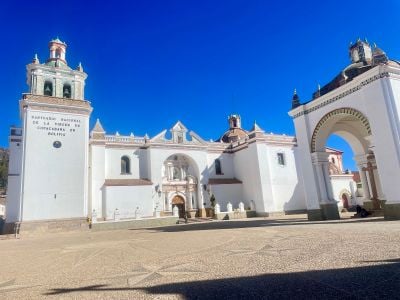
The Basilica of Our Lady of Copacabana is a white-walled church with grey stone trim and a cream and grey base course, built between 1669 and 1679 by the Spanish architect Francisco Jiménez de Siguenza. Its asymmetric facade has a square tower with a small arched belfry on the left, a curved pedimented section framing a recessed arched portal flanked by two columns with a niche above, and a dome on an arched drum to the right, beside a lower domed side chapel. The tower carries green and red tiled cupolas, and a cornice of small dark tiles crosses the upper facade. It stands on a stone-paved plaza.
Around 1576 the indigenous sculptor Francisco Tito Yupanqui carved the image of Our Lady of Copacabana, and an adobe shrine was built about 1583 at the foot of a hill sacred to the Inca as the Temple of the Sun. Augustinian friars took charge in 1589 and built their first chapel between 1614 and 1618. The present church was built between 1669 and 1679 by the Spanish architect Francisco Jiménez de Siguenza, replacing the earlier church, and was raised to minor basilica in 1940.
The basilica houses the Virgin of Candelaria, carved around 1580 by indigenous artist Francisco Tito Yupanqui, grandson of Inca Túpac Yupanqui. The image is crowned Queen of Bolivia. The open chapel attached to the nave, now with walled arches, served outdoor worship for indigenous pilgrims. The hilltop Calvario, with Stations of the Seven Sorrows and a crucifixion altar, draws crowds during Holy Week.
The basilica faces a stone-paved plaza in Copacabana, a short walk uphill from the lake shore. The open Chapel of the Indians is attached to the nave and can be seen from its west side, though its arches are walled up and modern buildings surround it. The Camarín of the Virgin, built by the Franciscans between 1910 and 1913, stands behind the main altar.
The image of the Virgin was carved around 1576 by the indigenous sculptor Francisco Tito Yupanqui, grandson of the Inca Túpac Yupanqui. On 22 April 2013 thieves entered the basilica by ladder and stripped the image of its gold and silver accessories, taking 28 items including the sculpture of the baby Jesus.
The community of curious travelers
AroundUs brings together thousands of curated places, local tips, and hidden gems, enriched daily by 92,605 contributors worldwide.