Intipunku, Archaeological site at Machu Picchu entrance, Peru.
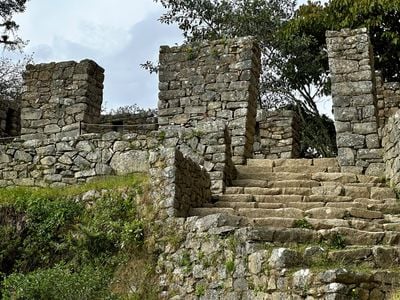
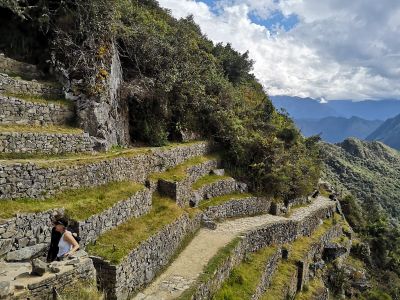
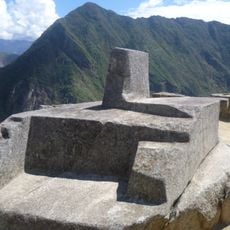
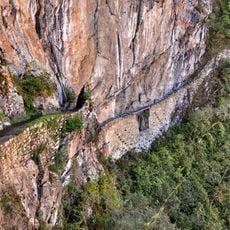
Intipunku is a dry-stone Inca complex of irregular grey and tan granite blocks set on a ridge southeast of Machu Picchu at 2,745 m. A high wall with a squared corner and two narrow openings faces a freestanding masonry column and a lower wall pierced by small rectangular niches. A raised rectangular enclosure with a flat earthen floor lies in the foreground; elsewhere two pillars flank a low wall whose opening is closed by a rope, with rough stone steps descending beside it.
The gate marked the principal entrance to the mountain sanctuary during the Inca Empire and served as a carefully designed checkpoint. Sentries would have controlled access to the site and verified all who entered this sacred place.
The name comes from Quechua: inti, sun, and punku, door. The site was dedicated to the cult of Inti, the Sun god, and because it sits on a ridge southeast of Machu Picchu, the rising sun passes through the gate each year at the summer solstice. Today it is the final stretch of the Inca Trail before hikers descend to the citadel.
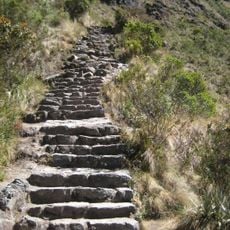
The site sits at high elevation and is reachable from Machu Picchu by following a marked trail that takes several hours to complete. The path climbs steadily and mixes stone steps with unpaved sections that can become slippery when wet.
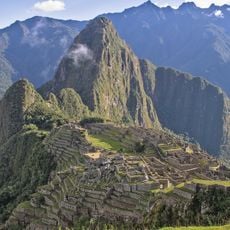
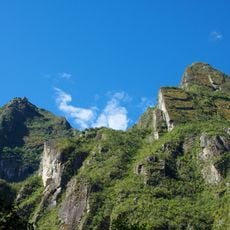
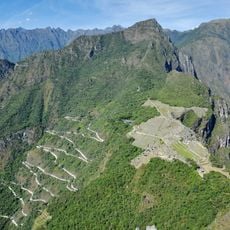
The name comes from Quechua: inti, sun, and punku, door. The rising sun passes through the gate on the summer solstice, and the site sits at 2,745 m, 290 m above Machu Picchu. From here Machu Picchu Mountain, Huayna Picchu, the Urubamba River and Putukusi Mountain are all visible.
The community of curious travelers
AroundUs brings together thousands of curated places, local tips, and hidden gems, enriched daily by 92,585 contributors worldwide.