Glaciar Martial, Glacier in Ushuaia, Argentina.
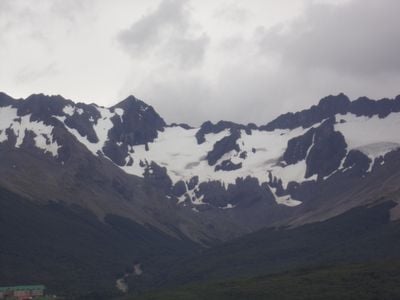
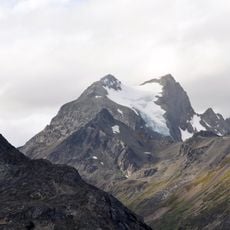
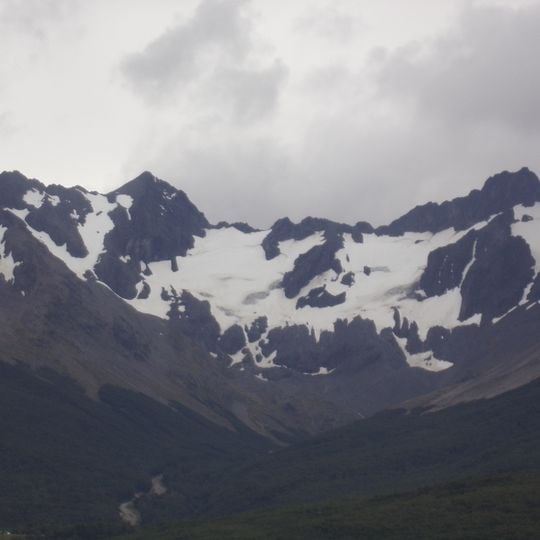
Glaciar Martial sits on the south slope of the Martial Mountains just north of Ushuaia, with its front at about 1,000 m above sea level. It is a small cirque glacier made up of three bodies of ice, the eastern one held in place by a rocky structure. Above dark rock and scree, snow and ice cover the upper face, broken by bare ridges.
Named after Louis Ferdinand Martial, commander of the French 1882–1883 Cape Horn scientific expedition sent to observe the transit of Venus, the glacier lost much of its surface in the second half of the 20th century. Between 1984 and 2003 it thinned by an average of 50 cm per year; the loss slowed from 2003 to 2011 with cooler summers and higher rainfall. Of its three bodies, the central one is the least stable.
The glacier and its three ice bodies are named after Louis Ferdinand Martial, commander of the French scientific expedition of 1882–1883 sent to observe the transit of Venus; his team wintered at Bahía Orange. The mountain centre at the foot of the ice operates year-round, with alpine skiing, snowboarding and sledding in winter and a 150-metre beginner slope fitted with a drag lift in 2015.
The mountain centre sits 7 km northwest of Ushuaia, about 5 minutes by car, with taxi stops at the base. In summer you walk 1,200–1,400 m up the ski slope to the platform facing the three ice bodies. Five marked trails start there: Bosque (150 m, easy), Filo (250 m, medium) and Glaciar (1,450 m, hard). Access to the facilities is free.
The Buena Esperanza stream, born from the glacier's meltwater, supplies 78% of Ushuaia's daily water. The water is hyposaline, bicarbonate-rich and highly transparent, with a pH near 7. Downstream, coliform contamination rises from land used for farming and tourism.
The community of curious travelers
AroundUs brings together thousands of curated places, local tips, and hidden gems, enriched daily by 94,076 contributors worldwide.