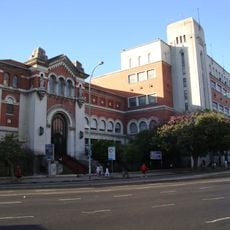
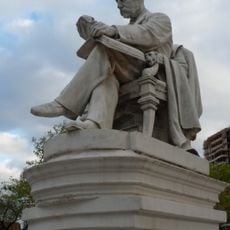
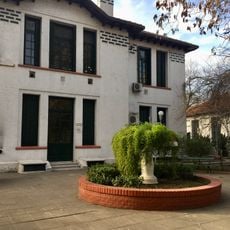
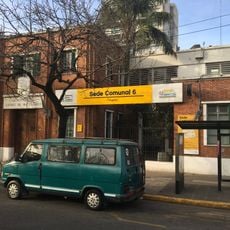
Bernardino Rivadavia Natural Sciences Museum, Natural sciences museum in Parque Centenario, Buenos Aires, Argentina.
The Bernardino Rivadavia Natural Sciences Museum is a natural history museum in Parque Centenario, Buenos Aires, holding 23 collections with around 1.5 million specimens. These are distributed across several exhibition halls that focus on birds, geology, aquariums, and paleontology.
Bernardino Rivadavia ordered the provinces to collect specimens in 1812, leading to the official founding in Santo Domingo Convent in 1823. In 1864, the institution began publishing the first Argentine scientific journal, presenting research by local naturalists.
The museum's name honours Bernardino Rivadavia, who in 1812 proposed a natural history museum and in 1823 promoted its building. Its first director was Italian botanist Carlos Ferraris, appointed in 1826, and German naturalist Hermann Burmeister led it from 1862, founding its first periodical in 1874.
The building was constructed in three stages between about 1925 and 1940; visitors enter through the southwest wing, where the exhibition begins. The thirteen permanent halls include an aquarium, an Antarctica display, a meteorite collection and a paleontology section, plus a science auditorium, art gallery, library and café. Allow several hours to cover them.
The museum's scientific journal traces its lineage to the Anales del Museo Público de Buenos Aires, first published in 1864 and described as the oldest scientific publication in Argentina. Its successor, the Revista del Museo Argentino de Ciencias Naturales, has appeared without interruption since 1999 in two annual issues, in May and November.
The community of curious travelers
AroundUs brings together thousands of curated places, local tips, and hidden gems, enriched daily by 92,725 contributors worldwide.