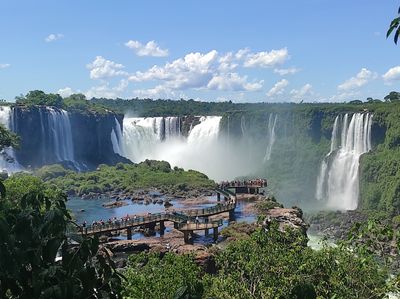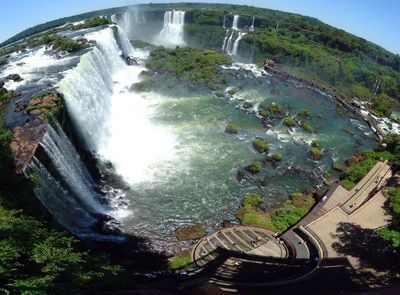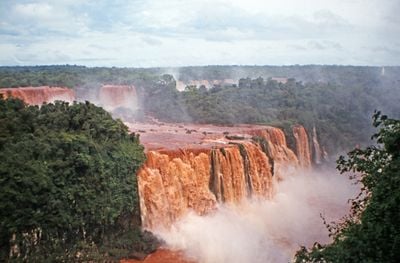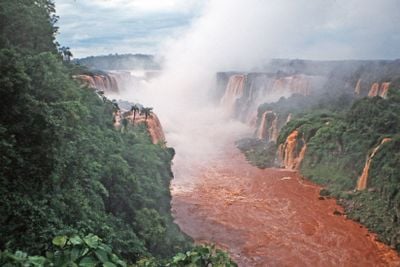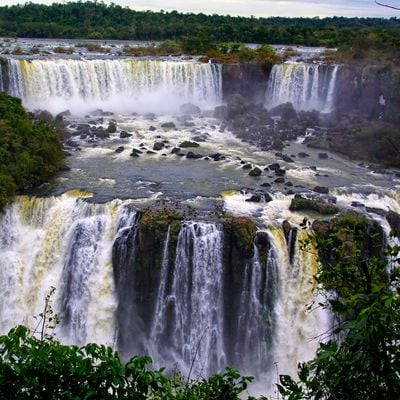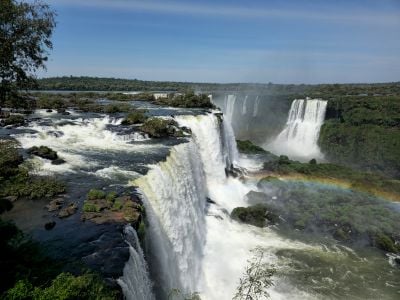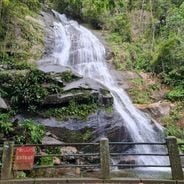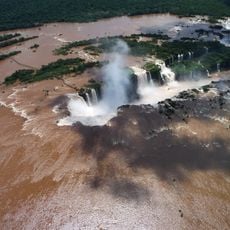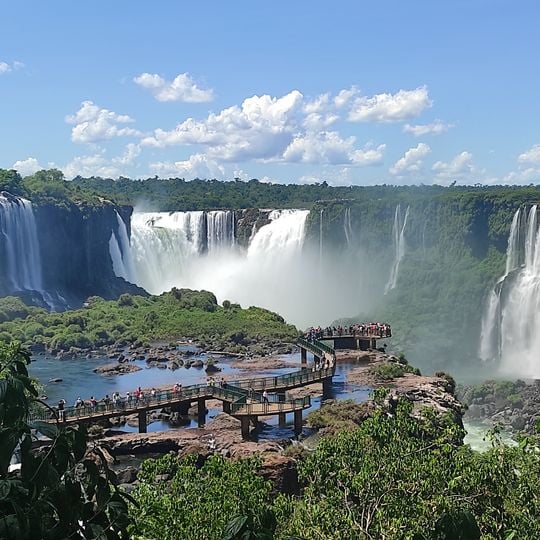
Iguaçu Falls, Waterfall system in Paraná, Brazil and Misiones, Argentina.
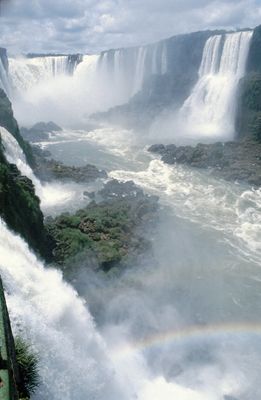
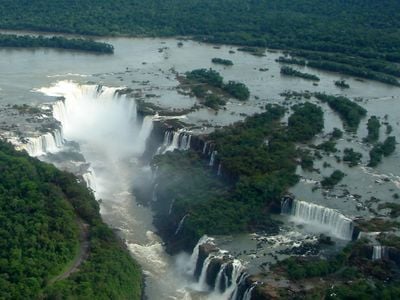
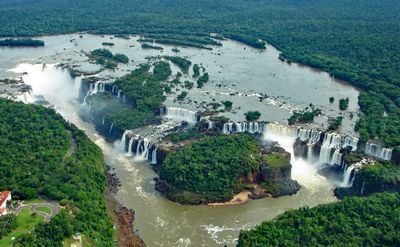
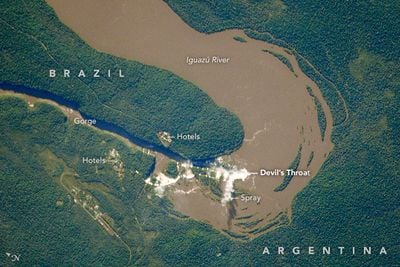
Iguazú Falls is a waterfall system in the Brazilian state of Paraná and the Argentine province of Misiones, extending along the border between both countries. Hundreds of individual cascades drop at various heights into the Iguaçu River, forming a jagged line that runs through several kilometers of rainforest.
A Spanish explorer reached the falls in the mid-16th century as the first European and brought word of their existence to the outside world. The two national parks were established in the 20th century to protect the area and regulate public access.
Local boat guides bring visitors close to the cascades while indigenous Guaraní craftspeople sell their work in wood and ceramics along park trails. The name comes from the Guaraní language and means great water, a term travelers see throughout the bilingual signage.
Visitors can explore both sides of the falls in a single day, with each side offering different viewpoints and walkways that lead close to the spray. The nearby airports in both countries are about a half-hour drive away, with regular shuttle buses running to park entrances.
The horseshoe canyon called Devil's Throat collects several waterfalls into a single roaring chasm that sends fine mist rising continuously and creates rainbows in sunlight. This section feels louder and more intense than the rest of the falls, drawing visitors who linger to watch the natural display.
Location: Misiones Province
Location: Paraná
Elevation above the sea: 180 m
Height: 82 m
Width: 2,700 m
Part of: Iguazu River
Website: https://iguazuargentina.com
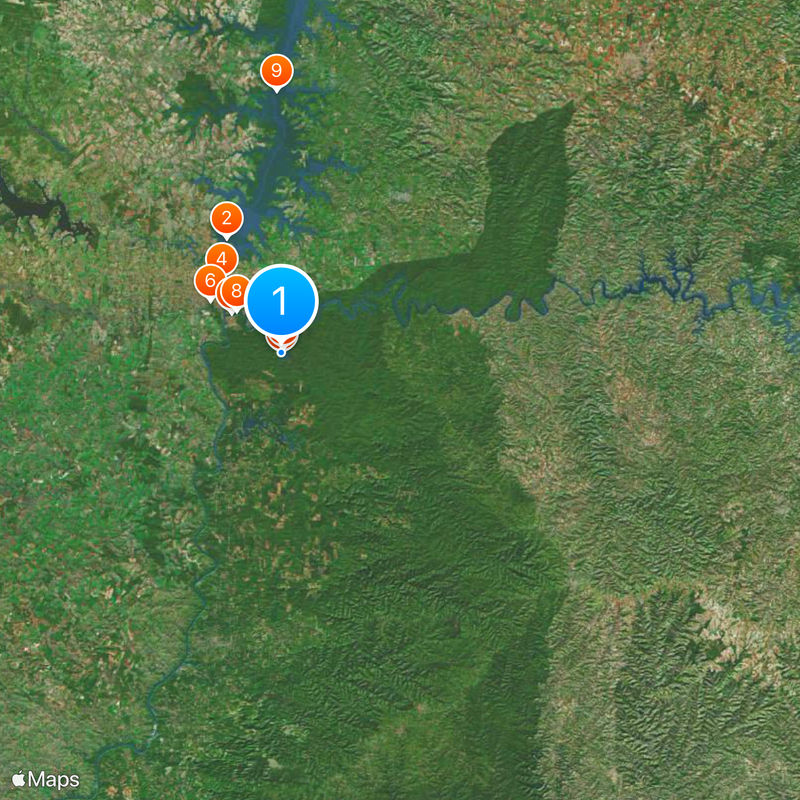
GPS coordinates: -25.69391,-54.43654
Latest update: December 2, 2025 20:11
From the highest peaks to coastal cliffs, this collection brings together geographically significant observation points across all continents. The locations offer views of mountain ranges, waterfalls, deserts, oceans, and notable architectural structures. The selection includes the Great Wall near Beijing, the Cliffs of Moher above the Atlantic, the Grand Canyon in Arizona, and Mount Everest on the Nepal-Tibet border. Among the waterfalls are Iguazú Falls between Brazil and Argentina, Victoria Falls between Zambia and Zimbabwe, and Niagara Falls between Canada and the United States. The Pyramids of Giza, the Alhambra in Granada, and the Taj Mahal in Agra showcase important architectural achievements from different eras. Natural formations such as Uluru in the Australian outback, Halong Bay in Vietnam, Banff National Park in the Canadian Rockies, and the Norwegian fjords demonstrate Earth's geological diversity. Additional locations include Santorini in the Aegean Sea, the Amazon rainforest, Horseshoe Bend on the Colorado River, Petra in Jordan, Mount Kilimanjaro in Tanzania, the Fitz Roy range in Patagonia, and Plitvice Lakes National Park in Croatia.
The Earth offers a wide range of geological shapes shaped over millions of years by weather and the movements of the land. In Northern Ireland, thousands of basalt columns stand along the coast, leftover from an ancient eruption. In Arizona, the Colorado River carved out a canyon more than 400 miles long. In Bolivia, a salt flat forms a giant mirror during the rainy season. You can also find white terraces formed by hot springs in Turkey, eroded sandstone arches in the American desert, or the largest coral reef in the world off Australia. Some formations show that volcanic activity still occurs, like in Yellowstone Park. Others are the result of tectonic plate collisions, such as the Himalayas where Mount Everest rises. These places tell the story of Earth's geology and are still changing under the influence of wind, water, and moving continents.
Brazil has numerous waterfalls and hot springs across its varied landscapes. At Iguaçu, water flows over 275 individual falls. The Chapada Diamantina region contains several waterfalls, including the 1,247-foot (380-meter) Cachoeira da Fumaça. Serra da Canastra is home to the 610-foot (186-meter) Casca d'Anta waterfall. Natural pools with clear water are found at Poço Azul and Lagoa Azul. The thermal springs at Ibirá provide mineral water at constant temperature. These locations are distributed across different regions of Brazil, from the southern Serra Gaúcha with Caracol cascade to the tablelands of Jalapão in the north. The waterfalls vary in height and volume. Some plunge over steep rock faces, while others flow through narrow canyons. Several of these sites are located in national parks or protected areas.
Itaipu Dam
35.4 km
Devil's Throat
205 m
Friendship Bridge
26.3 km
Iguaçu National Park
1.2 km
Saltos del Monday
24.5 km
Feirinha Puerto Iguazú
17.7 km
Tancredo Neves Bridge
17.1 km
Itaipu Reservoir
72.8 km
Estádio Olímpico Regional Arnaldo Busatto
123.4 km
Reserva natural estricta San Antonio
73.8 km
Buddhist Temple of Foz do Iguaçu
29.4 km
Parque das Aves
10 km
Rainforest Ecological Train
1.6 km
Omar Ibn Al-Khatab Mosque
24 km
Isla de San Martín
918 m
Parque Provincial de la Araucaria
109.5 km
Sierra de la Victoria
58.9 km
Parque provincial Cruce Caballero
98 km
Geoparque Horacio Foerster
56.7 km
Trinational Biodiversity Corridor
19.4 km
Estadio Juan Eudes Pereira
24.9 km
Estadio Km 12 Monday
34.9 km
Cathedral of San Juan Bautista
22.3 km
Iguazu National Park
16 km
Museo Municipal Adolfo Julio Schwelm
83.6 km
Cine Cataratas
22.3 km
Gramadão da Vila A
26.2 km
Hospital De Puerto Iguazú Marta Teodora Schwarz
17.4 kmReviews
Visited this place? Tap the stars to rate it and share your experience / photos with the community! Try now! You can cancel it anytime.
Discover hidden gems everywhere you go!
From secret cafés to breathtaking viewpoints, skip the crowded tourist spots and find places that match your style. Our app makes it easy with voice search, smart filtering, route optimization, and insider tips from travelers worldwide. Download now for the complete mobile experience.
A unique approach to discovering new places❞
— Le Figaro
All the places worth exploring❞
— France Info
A tailor-made excursion in just a few clicks❞
— 20 Minutes