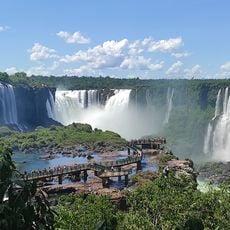
Devil's Throat, Waterfall at Iguazu Falls, Argentina and Brazil.
Devil's Throat is a U-shaped gorge about 150 metres wide and 80 metres high where the Iguazú River plunges over a dark rock ledge. The Salto Unión, on the Argentina-Brazil border, feeds the fall. A steel walkway leads to a viewing platform, and mist and rainbows rise from the base.
The Spanish explorer Álvar Núñez Cabeza de Vaca recorded the falls in 1541 or 1542 during an expedition toward Asunción; the first known European description appeared in his 1555 La relación y comentarios. The area stayed little explored for centuries because of dense forest and distance from colonial centres. In 1897 the Brazilian officer Edmundo de Barros proposed a protected area, and the Argentine park was created in 1934, the Brazilian one in 1939.
The name comes from the Tupi or Guarani words y (water) and ûasú (big). A Guarani legend tells that a god was to marry Naipi, who fled with her mortal lover Tarobá in a canoe; the god cut the river, creating the falls and condemning the lovers to an eternal plunge. The first European to record the falls was the Spaniard Álvar Núñez Cabeza de Vaca, in 1541 or 1542.
From the Argentine side, a gas-powered ecological train runs to Garganta del Diablo station, then a short train ride continues to Puerto Canoas, where a steel walkway leads to the viewing platform; the earlier wooden walkway was destroyed in the 1992 flood. Boats from downstream docks approach the base of the falls, and helicopter flights and full-moon night tours are also offered. The platform is among the most visited points of the park and stays crowded year-round.
Small birds nest near the roaring water and build their homes directly within the wet mist surrounding the falls. These birds are perfectly adapted to the extremely humid environment.
The community of curious travelers
AroundUs brings together thousands of curated places, local tips, and hidden gems, enriched daily by 92,638 contributors worldwide.