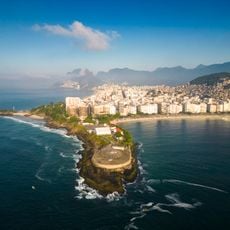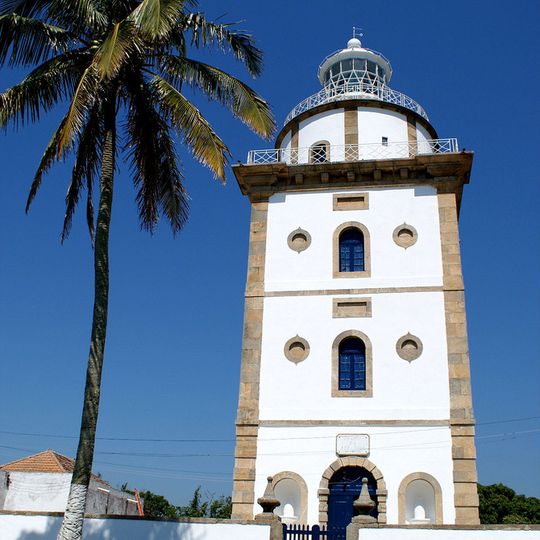
Farol da Ilha Rasa, Maritime lighthouse on Ilha Rasa, Brazil.
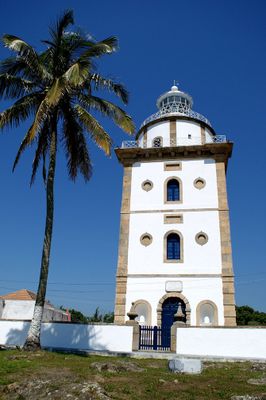
Farol da Ilha Rasa is a lighthouse on Ilha Rasa, about 11 km from Guanabara Bay. It is a three-storey square masonry building with exposed stone quoins, painted white, topped by a cylindrical tower with gallery and lantern, 26 m high with walls 1.3 m thick. The facade has a blue arched door flanked by blind arches and tall blue-paned windows.
King João VI ordered the lighthouse built; works began in 1819 using prisoners under engineer João de Souza Pacheco Leitão. The tower was finished in 1825, but Argentine pirates seized the ship carrying its French optical instruments, delaying inauguration. The light was finally lit on 31 July 1829, and on 2 December 1883 a new first-order lens by Lepaute et Sautter & Lemonnier was installed by engineer Louis Belenot.
The island and lighthouse are closed to public access, so the light is known mainly through its role guiding ships into Guanabara Bay. Four Navy petty officers keep it running in three-month rotations, living on frozen food and fruit from the island's mango, coconut, pitanga, lemon and persimmon trees.
The island and the lighthouse are closed to public access, so the structure can only be seen from the water. Four Navy non-commissioned officers keep the light running in three-month rotations, with mobile phone and internet access and frozen food brought from the mainland. The light shows two white flashes and one red every fifteen seconds.
The lantern holds one of only two mesoradial Fresnel lenses made by Barbier & Bernard; the other is in the Abrolhos lighthouse in Bahia. The island and lighthouse are closed to public access, and four Navy petty officers keep the light running in three-month rotations, using a 0.5 hp electric motor with the old equipment kept for emergencies.
The community of curious travelers
AroundUs brings together thousands of curated places, local tips, and hidden gems, enriched daily by 92,783 contributors worldwide.