Fort Copacabana, Coastal fort and army museum in Copacabana, Rio de Janeiro, Brazil
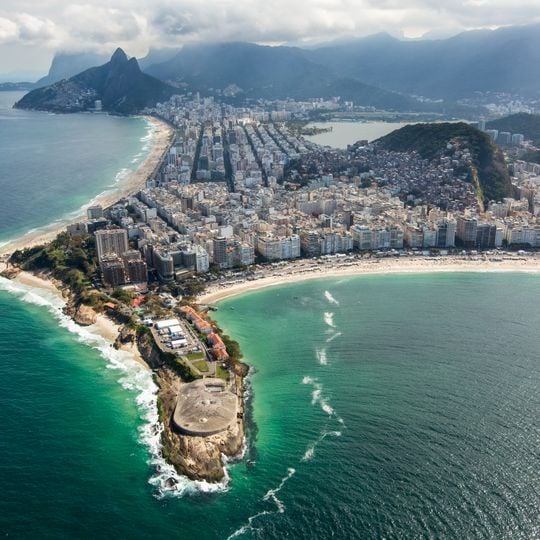
Fort Copacabana is a military fortress at the southern end of Copacabana Beach. It houses two armored cupolas with large Krupp cannons and functions today as an Army museum displaying exhibitions on Brazilian military history from colonial times forward.
Construction began on 5 January 1908, when President Afonso Pena and War Minister Hermes da Fonseca attended the laying of the foundation stone on the Ponta da Igrejinha. The Krupp guns arrived disassembled from Germany in five thousand crates, landed at a pier built for the purpose. The fort opened on 28 September 1914, was rated first class, and was then considered South America's most modern stronghold.
The headland once held a small chapel with a replica of the statue of Our Lady of Copacabana, patron saint of Bolivia, which gave the fort its name. The army's historical museum inside covers different periods of Brazilian military history, and the Café do Forte is a branch of the traditional Colombo confectionery.
The fort covers 114,169 m², with 40,000 m² built, so allow time to walk between the museum, the cupolas and the artillery park. Guided tours run Tuesday to Sunday, 10 am to 4 pm, entered from Coronel Eugênio Franco Square. A bike path, the Marechal Rondon, crosses the interior. Visitors can choose a restricted visit of the outer areas or a complete one including the fort interior and museum.
The two armoured cupolas are among the last Krupp heavy fortress cupolas still in place anywhere outside Taranto, Italy. The upper one, named Duque de Caxias, holds two 305 mm guns called Barroso and Osório, which threw 445 kg shells up to 23 km; the lower André Vidal cupola carries 190 mm guns. The 305 mm turret sits behind and above the smaller one so it could fire over it.
The community of curious travelers
AroundUs brings together thousands of curated places, local tips, and hidden gems, enriched daily by 94,043 contributors worldwide.