Museu Nacional de Belas Artes, Art museum in Centro, Rio de Janeiro, Brazil.
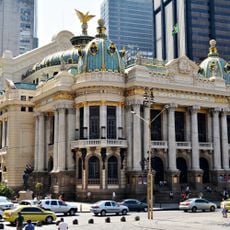
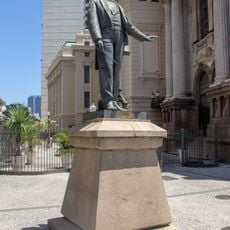
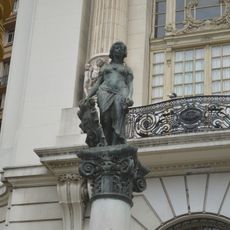
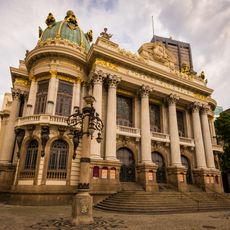
The Museu Nacional de Belas Artes occupies an eclectic building on Avenida Rio Branco, designed by Spanish architect Adolfo Morales de los Rios with the Louvre as model and opened in 1908. Its main facade, in French Renaissance style, has pediments, colonnades and terracotta reliefs of ancient civilizations, plus medallions painted by Henrique Bernardelli. The side facades refer to the Italian Renaissance and carry Parisian mosaics of architects and painters such as Vasari, Vitruvius and Leonardo da Vinci; the rear facade is neoclassical, with reliefs by Edward Cadwell Spruce.
The institution was founded in 1937, incorporating collections brought to Brazil by Dom João VI of Portugal and left behind when he returned to Europe in 1821. The imperial art academy managed the works for decades until the republic established the current museum as a national center for fine arts.
The museum's name comes from the National School of Fine Arts, whose collection became the museum's own in 1937. The Jeronymo Ferreira das Neves collection, donated to the school in 1947, went with it to the Fundão campus and now forms the Museu Dom João VI. The museum's library holds rare works, periodicals and exhibition catalogues documenting the institution since the Imperial Academy.
The entrance is on Avenida Rio Branco in the city center, near several metro stations and bus lines. The galleries spread across multiple floors, so a visit through the main rooms can take about two to three hours.
The collection includes an ancient marble bust of Antinous, given by Empress Teresa Cristina to the imperial art academy in 1880. The piece dates from the Roman Empire and is one of the few ancient sculptures held in Brazilian museums.
The community of curious travelers
AroundUs brings together thousands of curated places, local tips, and hidden gems, enriched daily by 92,933 contributors worldwide.