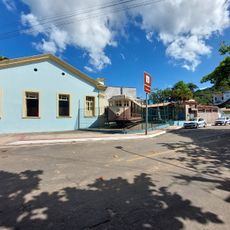
Penha Convent, Religious sanctuary on coastal cliff in Vila Velha, Brazil.
The Penha Convent stands on a 154-metre rock outcrop above Vila Velha: white rectangular wings with dark windows and reddish-brown tiled roofs, a small white cupola with a cross at the highest point and a taller white cross beside it. Inside, much of the woodwork is cedar carved by José Fernandes Pereira between 1874 and 1879.
Construction began in 1558 under the Spanish friar Pedro Palácios, who was later charged with building a hermitage on the Penha hill and ordered an image of Our Lady from Lisbon. In 1562 he built a chapel dedicated to Saint Francis of Assisi on the site of the present Campinho. The complex was listed as a historic heritage site by IPHAN in 1943.
The convent serves as a gathering place where people come to pray in the chapel and walk through the sacred rooms. The site hosts important religious gatherings and celebrations that have brought communities together for centuries.
The site sits high on a hilltop, so visitors should wear comfortable shoes and be ready for uneven terrain. Access to some areas may be limited, so it's wise to allow time for exploration and navigate the grounds carefully.
The main altar holds over 200 pieces cut from 19 kinds of marble; it was built around 1800 in Rococo style and restored in 1910 and again between 2009 and 2011. Four paintings by Benedito Calixto, made in 1926 and 1927, hang in the convent and show the building, Friar Palácios and moments of Vila Velha's past.
The community of curious travelers
AroundUs brings together thousands of curated places, local tips, and hidden gems, enriched daily by 93,630 contributors worldwide.