Bahia Museum of Art, Art museum in Corredor da Vitória, Salvador, Brazil
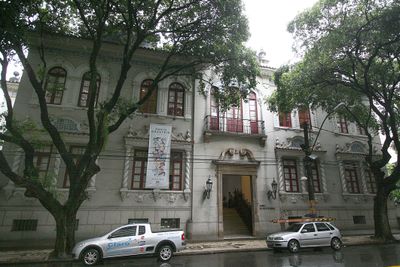
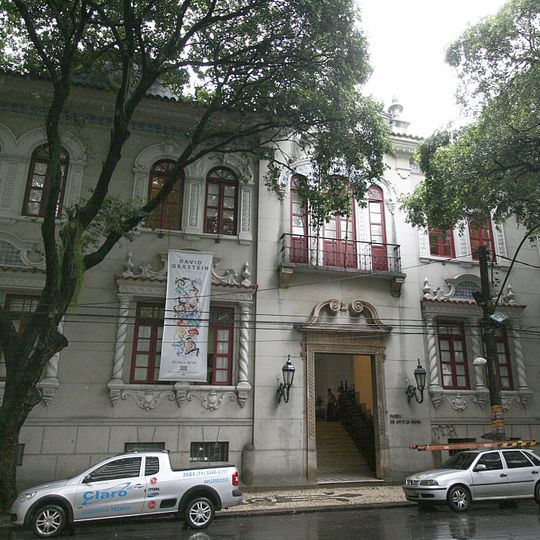
The Bahia Museum of Art occupies the Palácio da Vitória, a two-story grey stone building with a symmetrical facade. Its ground floor has four tall rectangular windows with dark red frames in carved stone surrounds and a central arched doorway topped by a stone pediment; the upper floor has four arched windows with dark red frames and small metal-railed balconies. A low stone plinth runs along the base.
The institution was established in 1918 and holds the distinction of being Bahia's oldest state museum. It relocated to its current location in 1982 after being housed in earlier sites.
The museum's name comes from its 1918 founding as the Museu do Estado, later renamed Museu da Bahia and then Museu de Arte da Bahia. Its core is the collection of English physician Jonathas Abbott, who gathered nearly 400 paintings in Salvador, including works of the Bahian school by José Joaquim da Rocha and José Teófilo de Jesus. The state bought most of it in 1871.
The museum occupies the Palácio da Vitória, a two-storey neocolonial building on a wet street; the entrance is the central arched doorway under a stone pediment. Inside are a specialised library of about 12,000 books and an auditorium. Look for the white banner reading "DAVID GERSTEIN" and "PAN AMERICANA ARTE CONTEMPORANEA" hung between the ground-floor windows.
The museum's core came from English physician Jonathas Abbott, who settled in Salvador and assembled nearly 400 paintings, many by Bahian colonial masters such as José Joaquim da Rocha and José Teófilo de Jesus. The province bought most of the collection from his family in 1871, and it reached the museum in 1925.
The community of curious travelers
AroundUs brings together thousands of curated places, local tips, and hidden gems, enriched daily by 92,814 contributors worldwide.