BINGO, Radio telescope in Aguiar, Brazil
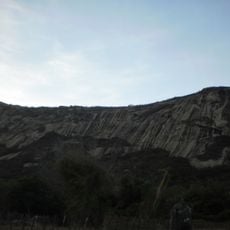
BINGO is a 40 m transit radio telescope under construction in the Serra do Urubu, near Aguiar, Paraíba. Its 40-meter primary mirror reflects sky radiation to a secondary mirror, which directs it to a focal plane of 28 horns feeding a receiver and spectrometer. It will map redshifted 21 cm hydrogen emission between z = 0.13 and 0.45 over a 15° declination strip as the sky drifts past.
The BINGO project is an international collaboration led by the University of São Paulo, with Elcio Abdalla of its Institute of Physics as supervising researcher, and partners including INPE and UFCG in Brazil, Yangzhou University in China and the University of Manchester in England. It is financed mainly by FAPESP and the Paraíba state government. In March 2018 assembly and horn fabrication were under way in Brazil, with completion expected around 2022.
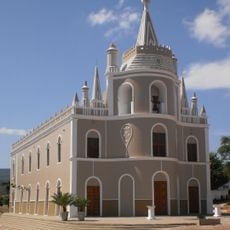
BINGO stands for Baryon Acoustic Oscillations from Integrated Neutral Gas Observations, not "Neutral Galaxies Observatory". The project is led by the University of São Paulo under researcher Elcio Abdalla, with funding mainly from FAPESP and the Paraíba state government. In Aguiar, cosmology supports a STEAM programme in local schools backed by the Federal University of Campina Grande, and a science museum devoted to astronomy is planned in the backlands, housing the telescope's control room.
The site sits in northeastern Brazil in a region with minimal radio interference and favorable atmospheric conditions for observations. Visitors should understand this is a specialized research facility with potentially limited public access.
The telescope specializes in measuring baryon acoustic oscillations, a subtle signal from distant galaxies that reveals information about the accelerated expansion of the universe. This technique allows scientists to probe the mystery of dark energy.
The community of curious travelers
AroundUs brings together thousands of curated places, local tips, and hidden gems, enriched daily by 92,815 contributors worldwide.