Devil's Peak, Mountain summit in Cape Town, South Africa
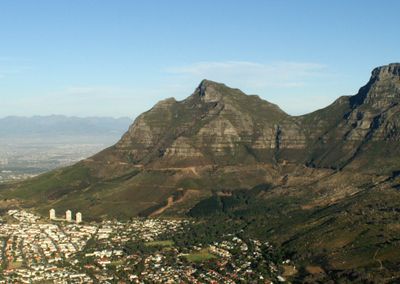
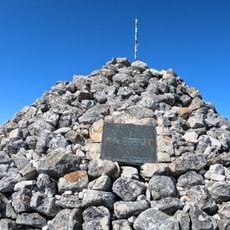
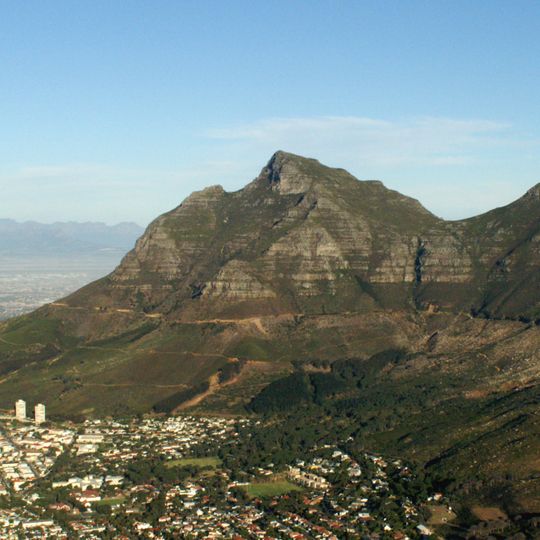
Devil's Peak is a 1,000-metre sandstone summit on the eastern side of Table Mountain, its layered grey and tan rock rising to a single pointed peak above Cape Town. Horizontal bands of stone alternate with ledges of brownish and green fynbos, a rounded shoulder extends left of the peak, and a long ridge descends to the right toward the city and trees below.
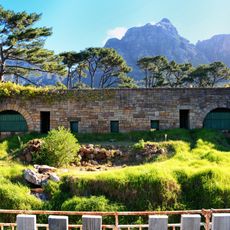
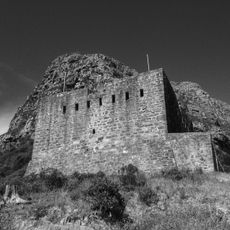
The mountain became part of the early European settlement in 1652 when Jan van Riebeeck established a Dutch East India Company post. Over time, defensive structures and military installations were built on the slopes to protect the expanding settlement.
The name comes from a legend about the pirate van Hunks, who settled on the peak in the early 18th century and won a smoking contest against a stranger who turned out to be the devil; the smoke became the cloud cover known as the tablecloth of Table Mountain. The name was earlier Taubenspitze (dove's peak), and Dutch speakers confused the similar-sounding words for dove and devil.
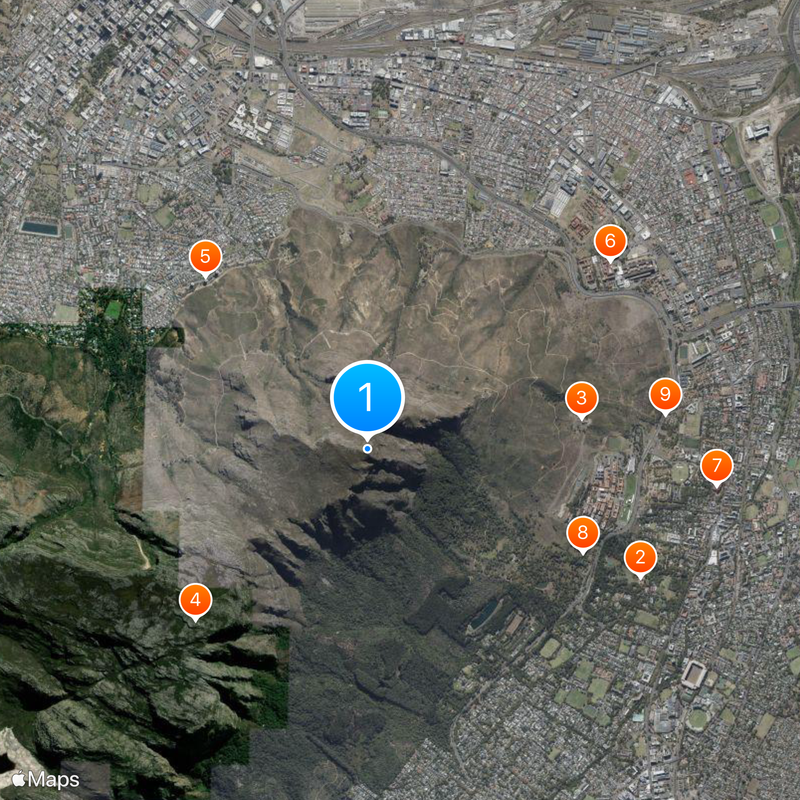
Hikers reach the saddle between Devil's Peak and Table Mountain via Newlands Ravine or Saddle Ravine, then follow a straightforward path to the summit. As of January 2026 crime poses a threat on the lower slopes, so access is advised through Newlands Forest. Avoid Second Waterfall Ravine, which has been linked to fatalities.
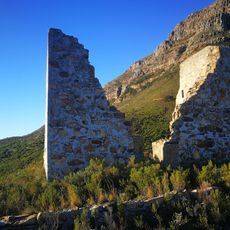
The name may come from a Dutch pun: the peak was once called Taubenspitze (Dove's Peak), and "duif" (dove) sounded close to "duiwel" (devil). A 1795 British blockhouse built by General Sir James Craig, the Lion's Blockhouse, is a national monument. An abandoned fire lookout sits high on Mowbray Ridge.
The community of curious travelers
AroundUs brings together thousands of curated places, local tips, and hidden gems, enriched daily by 93,010 contributors worldwide.