D'Estaville, Renaissance Revival mansion in Kew, Melbourne, Australia
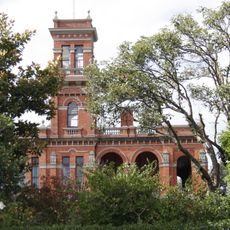
D'Estaville is a two-storey Italianate villa at 7 Barry Street, Kew, built of bluestone with rock-faced quoins and window surrounds, and coursed squared rubble walls. It has low-pitched slate roofs, a cornice with trapezoidal brackets, and eaves pierced with diamond and eight-pointed star shapes. A large Serlian window marks the western elevation.
d'Estaville was completed in 1859 for Sir William Foster Stawell, a politician and long-serving Chief Justice of Victoria, to designs by Knight & Kerr, the architects of Parliament House. In 1888 Stawell, in failing health, subdivided and sold part of the 13-hectare estate along Princess Street; the house and sloping river land stayed with the family until 1904. It was listed on the Victorian Heritage Register in 1974.
The house's name echoes the Stawell family's French Huguenot ancestry, and its 1859 Italianate design by Knight & Kerr, the architects of Parliament House, is the only known surviving residence they designed. Visitors can spot the diamond- and eight-pointed-star-shaped holes cut into the eaves, a decorative detail of the original design.
The house stands at 7 Barry Street in Kew, on steeply sloping land that once ran down to the Yarra River. The 13-hectare estate was subdivided from 1888 onward, so the mansion now sits on a reduced block. It is a private residence and was entered on the Victorian Heritage Register in 1974; visitors view the bluestone exterior and rock-faced quoins from the street.
The house lacks the cupola, a square tower with bracketed cornices that is usual in Italianate villas. Diamond and eight-pointed star shapes are cut into the eaves as decoration, and the corners and window surrounds use bluestone blocks with axed edges and rock-faced centres.
The community of curious travelers
AroundUs brings together thousands of curated places, local tips, and hidden gems, enriched daily by 94,100 contributors worldwide.