Dunedin Town Hall, Town hall in Dunedin, New Zealand
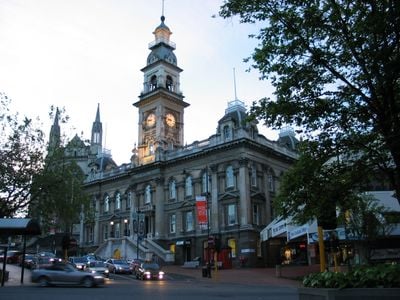
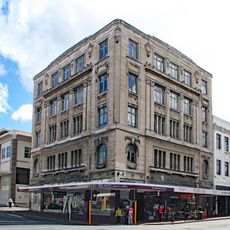
Dunedin Town Hall occupies a full block between The Octagon and Moray Place. Its first stage, opened in 1880, is a three-storey office block: Port Chalmers breccia at ground level, Oamaru limestone above, a double stair to the first-floor entrance, and a 47-metre tower with a clock and bells ordered from Gillett & Bland of London. The rear elevation was left unfinished, with bricked-in openings meant for a future auditorium.
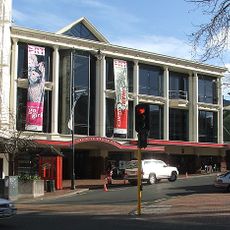
Dunedin's first wooden town offices were demolished in 1859; after a design competition, Robert Lawson reworked Thomas Bedford Cameron's winning entry and supervised construction. The foundation stone was laid on 23 May 1878 and the offices opened on 25 May 1880, costing £20,000 once the Gillett & Bland clock was installed. A second competition in 1913 was won by Harry Mandeno in 1914, adding two auditoriums by 1928.
The name is ambiguous: the 19th-century office block was popularly called the town hall although it had no auditorium, and the 1913–14 competition design by Harry Mandeno, likely drawn by Roy Fraser, added two halls. In the 1980s the additions were officially renamed The Dunedin Centre, a name few people can place.
The building sits centrally in the city and is easy to reach on foot from the downtown area, especially from The Octagon. Visitors should expect the interior layout to be complex in places and that certain areas may be closed off during performances or events.
The building was constructed using breccia stone from Port Chalmers in the basement and Oamaru limestone in the upper levels, reflecting local building materials. This choice of materials shapes the appearance of the structure and ties it to the region's natural resources.
The community of curious travelers
AroundUs brings together thousands of curated places, local tips, and hidden gems, enriched daily by 93,404 contributors worldwide.