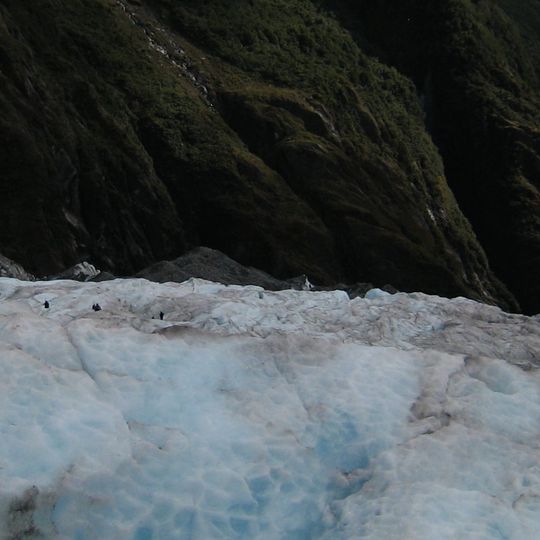
Franz Josef Glacier, Temperate maritime glacier in Westland National Park, New Zealand.
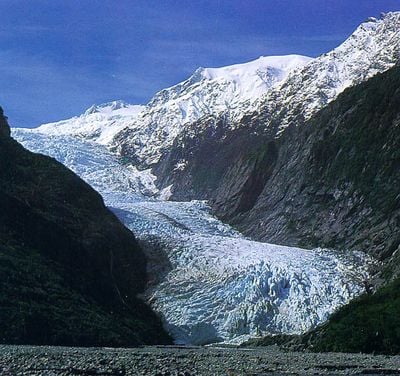
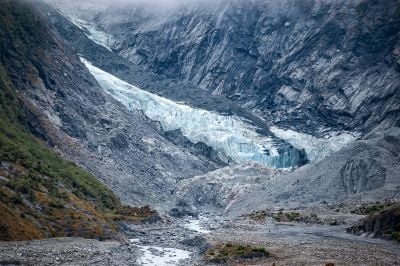
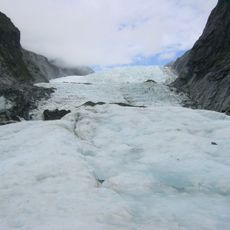
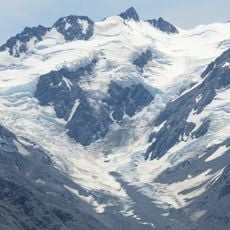
Franz Josef Glacier is a 12-kilometre temperate maritime glacier in Westland Tai Poutini National Park on New Zealand's South Island. It descends from a névé over 2,500 metres above sea level to a terminus at 300 metres, ending in a low wall of broken grey ice on loose rock and gravel. Pale blue and white ice, scored by crevasses and ridges, fills a steep valley between dark slopes.
German geologist Julius von Haast named the glacier after Emperor Franz Joseph I of Austria in 1865 during an expedition studying German settlers. Since then, the glacier tongue has retreated and advanced multiple times, responding strongly to climate changes.
The Māori name Ka Roimata o Hine Hukatere means the tears of Hine Hukatere and recalls a woman whose lover died in an avalanche. The legend tells that her tears froze into ice and shaped the glacier.
The glacier terminus sits at about 300 metres above sea level, 19 kilometres from the Tasman Sea. The Waiho River flows out from the ice; the access road bridge was destroyed by floods in 1989 and again in April 1991. The glacier can be reached on foot from the village of Franz Josef, but the terrain is steep and weather changes quickly.
The area receives up to 15 meters of snowfall per year in the upper accumulation zone, one of the highest precipitation rates worldwide. This enormous snow mass causes the ice to flow faster than most other glaciers.
The community of curious travelers
AroundUs brings together thousands of curated places, local tips, and hidden gems, enriched daily by 93,359 contributors worldwide.