Bridge of Remembrance, Heritage footbridge in Christchurch City, New Zealand.
The Bridge of Remembrance is a light grey stone archway built over the east end of the Cashel Street bridge, which links Oxford and Cambridge Terraces across the Avon River / Ōtākaro. A wide central arch is flanked by two smaller arched openings at its base, with carved wreaths in the spandrels and circular bronze medallions on the left and right faces. The words "BRIDGE OF REMEMBRANCE" are incised along the flat top beneath a circular medallion, and below the right medallion the names PALESTINE, EGYPT and GALLIPOLI are cut into the stone. William Gummer of Prouse and Gummer designed the arch, which carries a Latin inscription and decorative lions carved by Frederick Gurnsey.
A wooden bridge over the Avon River at Cashel Street, built by Edward George Wright and finished in May 1873 for £509, was later given a stone memorial arch. The idea came from a letter by Mrs Wyn Irwin to The Press on 24 July 1919. Construction began on 23 January 1923; Lord Jellicoe laid the cornerstone on Anzac Day 1923 and unveiled the memorial on Armistice Day, 11 November 1924. After the February 2011 earthquake damaged the arch, repairs costing NZ$6.7m were completed and the bridge was rededicated on Anzac Day 2016.
The bridge's name comes from a 1919 letter to The Press by Mrs Wyn Irwin proposing a memorial arch. Since Anzac Day 1977 the deck has been a pedestrian precinct, and rededication ceremonies are held on Anzac Day, as in 2016. Carved rosemary and laurel wreaths refer to remembrance.
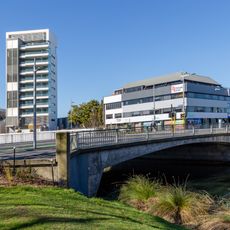
The archway stands over the east end of the Cashel Street bridge, linking Oxford Terrace on the west bank with Cambridge Terrace on the east over the Avon River / Ōtākaro. It has been closed to motorised traffic since 1976 and became a pedestrian precinct on Anzac Day 1977. East of the arch are the business district and City Mall; between the bridge and Victoria Square lie the Floral Clock, the Law Courts, the Canterbury Provincial Council Buildings and the Scott Statue.
The arch was designed by William Gummer of Prouse and Gummer, chosen from 24 competition entries; he also designed the Dunedin Cenotaph. Look for the decorative lions carved by Frederick Gurnsey (1868–1953), and a plaque honouring Charles Upham, New Zealand's double Victoria Cross recipient.
The community of curious travelers
AroundUs brings together thousands of curated places, local tips, and hidden gems, enriched daily by 94,072 contributors worldwide.