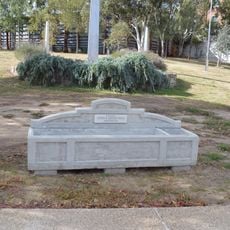
Blackguard Gully, Heritage mining site in Young, Australia
Blackguard Gully is a mining site stretching along Whiteman Avenue in Young, New South Wales, featuring natural rock formations and remnants of gold extraction from the 1860s. The heritage reserve today has informational panels that explain the geological features and evidence of past mining operations left visible across the landscape.
Gold was found at Lambing Flat in March 1860, and within a year thousands of European and Chinese miners were working the field. On 30 June 1861 about 3,000 European miners marched from Tipperary Gully to Blackguard Gully under a "Roll-up, Roll-up, No Chinese" banner, burning tents and cutting off pigtails. After Premier Charles Cowper's visit in March 1861, Chinese miners were restricted to Blackguard Gully. The site was added to the New South Wales State Heritage Register on 13 March 2009.
After Premier Charles Cowper's visit on 2 March 1861, Chinese miners on the Burrangong goldfields were restricted to Blackguard Gully because the Legislative Council had not passed his laws to protect them. The name comes from the gully itself, where European miners marched with a banner reading "Roll-up, Roll-up, No Chinese" on 30 June 1861.
The site is accessible via Whiteman Avenue and can be explored on foot, with signage helping visitors navigate the area. Wear comfortable shoes as the ground is uneven and features natural rock formations that require careful walking.
Archaeological investigations uncovered evidence from the 1860s in undisturbed areas, revealing how miners lived and worked at that time. These findings provide insight into everyday objects and tools that miners left behind and that have been preserved underground.
The community of curious travelers
AroundUs brings together thousands of curated places, local tips, and hidden gems, enriched daily by 94,125 contributors worldwide.