Epping Forest National Park, Scientific national park in central Queensland, Australia.
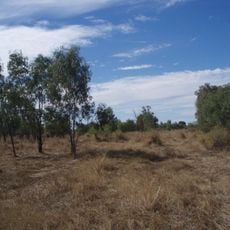
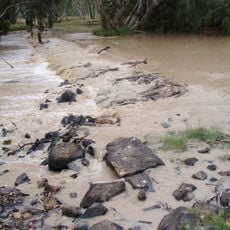
Epping Forest National Park is a flat, gently sloping clay pan in central Queensland, 855 km northwest of Brisbane, crossed by Fox Creek, a tributary of the Belyando River that does not carry water all year. Most of the park is open eucalypt woodland, with scattered patches of sandy soil where the wombats dig their burrows. The terrain lies at about 230 m elevation.
Epping Forest National Park was gazetted to protect the northern hairy-nosed wombat, the world's largest burrowing herbivore. By the 1970s the population had fallen to an estimated 20–30 animals. A 2007 census counted about 138 individuals. The park is managed as an IUCN Category Ia strict nature reserve, and only scientists, rangers and volunteers may enter.
The park's name comes from Epping Forest, the woodland in England; the Queensland reserve protects the northern hairy-nosed wombat, the world's largest burrowing herbivore. Rangers, scientists and volunteers are the only people allowed inside, and their surveys count the animals and check the eucalypt woodland and sandy burrowing patches.
Access is restricted and requires special authorization for researchers, rangers, and designated volunteers involved in scientific work. Prospective visitors should check current access requirements and submit necessary applications in advance.
The northern hairy-nosed wombat is the world's largest burrowing herbivore, and Epping Forest is its only remaining natural habitat. A 2007 census counted about 138 animals, up from an estimated low of 20 to 30 in the 1970s. The park is managed as an IUCN category Ia strict nature reserve, stricter than a national park.
The community of curious travelers
AroundUs brings together thousands of curated places, local tips, and hidden gems, enriched daily by 92,665 contributors worldwide.