World War I Cenotaph, Mackay, War memorial in Jubilee Park, Mackay, Australia.
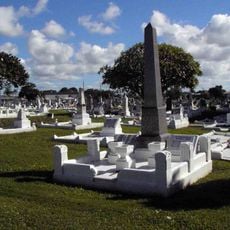
The World War I Cenotaph stands in Jubilee Park on Albert Street, Mackay, facing the park's opposite side after its 1973 move. Designed by Townsville architect Stephen Harvey and built by Melrose & Fenwick in 1928–29, it commemorates the 159 local men killed in World War I, eight of them decorated. The monument's form and materials follow the heritage listing.
Designed by Townsville architect Stephen Harvey and built by Melrose & Fenwick in 1928–29, the cenotaph was unveiled in 1929 on the southern bank of the Pioneer River beside the Sydney Street Bridge. It commemorates the 159 men from Mackay and its district killed in World War I. In 1945 it was moved to the northern edge of Jubilee Park, and in 1973 it was relocated again to front Albert Street when the council planned its civic centre.
The word cenotaph means "empty tomb", a substitute grave for Australians buried where they fell, as British policy decreed. Before 1929 Anzac Day centred on a temporary Cross of Sacrifice; since then the monument has anchored Anzac and Remembrance Day services, with other war memorials later erected around it.
The cenotaph is accessible year-round within Jubilee Park and serves as the central gathering point for Anzac Day and Remembrance Day ceremonies. The park provides open pathways leading to the monument with space for visitors to pause and reflect.
Before the cenotaph existed, Anzac Day in Mackay centred on a temporary Cross of Sacrifice, with wreaths, local band music and speeches. By the mid-1920s a Fallen Soldiers Memorial Committee of about 20 members, including returned soldier G. Hoffman, raised funds for a permanent monument. Eight of the 159 men named on it received military decorations.
The community of curious travelers
AroundUs brings together thousands of curated places, local tips, and hidden gems, enriched daily by 93,023 contributors worldwide.