Canecutters Memorial, White marble monument at Fitzgerald Esplanade, Innisfail, Australia
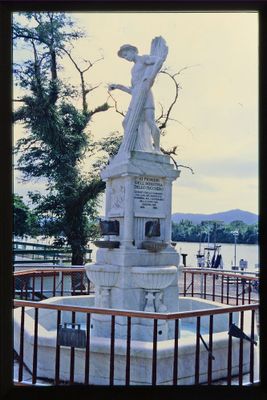
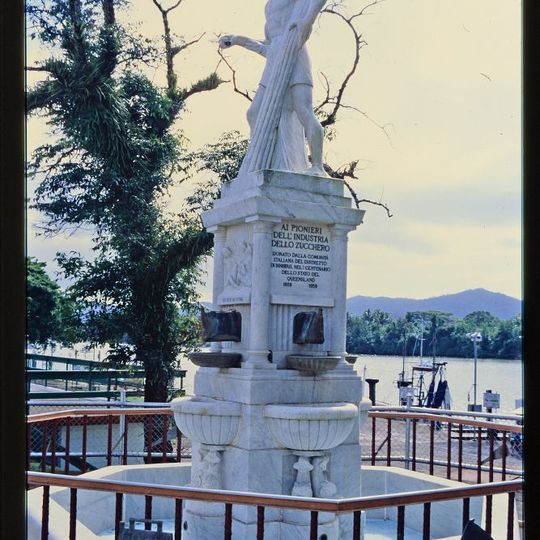
The Canecutters Memorial is a white marble monument at the eastern end of Edith Street on Fitzgerald Esplanade, overlooking the Johnstone River. It consists of an octagonal pool from which rises a square plinth with a water fountain and bowl on each face, topped by a life-size statue of a man cutting cane by hand. The cane cutter wears shorts and a hat and holds a cane knife in his right hand, with a sheaf of standing sugar cane under his left arm and across his back. Two opposing faces of the plinth feature bas-reliefs of cane cutters at work.
The memorial was constructed in 1959 to mark Queensland's centenary of separation from New South Wales. It was created during a period when the sugar industry was reshaping the region's economy and the contributions of workers like Italian immigrants were driving development.
The Italian community of Innisfail commissioned this memorial to honor their role in developing the sugar industry locally. You can see how their contribution shaped the region and remains visible in the monument's design and inscriptions.
The memorial stands on a small sealed area among trees and a grassed park at the eastern end of Edith Street, overlooking the Johnstone River. The ground east of the monument slopes steeply down to the river, so approach from the esplanade side. The octagonal pool and plinth can be viewed from all sides.
The monument was designed by Italian artist Renato Beretta and carved from Carrara marble in Italy before being transported to Australia. This choice of material and sculptor connected the Italian heritage of the workers to the memorial honoring their labor.
The community of curious travelers
AroundUs brings together thousands of curated places, local tips, and hidden gems, enriched daily by 92,705 contributors worldwide.